

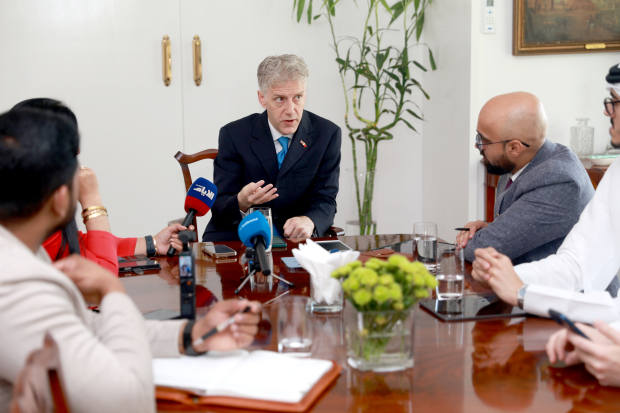
Bahrain could see its bilateral trade relationship with the UK hit and exceed the £2 billion (BD1bn)mark once the GCC’s first comprehensive trade pact with a G7 nation comes into effect, according to British Ambassador Alastair Long.
During a Press roundtable held yesterday, Mr Long noted that 99 per cent of tariffs will be lifted on trade between the two parties once the GCC-UK Free Trade Agreement comes into effect.
“We have reached agreement on the text of the treaty, and last week, our Trade Minister Chris Bryant and the GCC Secretary General Jasem Mohamed Albudaiwi initialled it at Number 11 Downing Street, the Chancellor of the Exchequer’s house,” Mr Long told reporters.
“The text will now go through a legal scrub so lawyers can make sure it’s all completely consistent – both the Arabic and English copies.
“At the end of that process, the text will then be ready for a formal signature between the parties. The process is likely to take months, not weeks, but can be done in as little as a couple of months.
“After the official signatures, it may take a year before the agreement enters into force. As soon as this happens, tariffs on a whole range of products will be lifted.”
Mr Long noted that both UK and GCC producers, including Bahraini entrepreneurs, would benefit from easy access to each other’s markets, adding that this was a ‘modern’ free trade agreement, so it goes beyond lifting tariffs.
The agreement would make ‘business in all spheres’ smoother by aligning rules and regulations, including in digital goods and services.
“In effect, any Bahraini business is going to find that they are now able to export to the UK much more easily and cost-effectively,” he added.
“This is a fantastic new platform for Bahrain and the UK – our bilateral trade is £1.3bn currently and we want to see that really leap forward – we’re looking to get it over £2bn as soon as possible.”
According to the UK government, this deal will remove an estimated £580 million (BD293m) annually in duties on current UK exports to the GCC, once the agreement is fully implemented, with £360m (BD182m) of estimated duties to be removed on day one of the agreement entering into force.
“That sounds like a benefit to the UK, but remember, that means the UK will be sending more products to the GCC – more customer choice and more UK products available on the shelves in Bahrain,” Mr Long added.
The agreement also includes provisions on data sovereignty, enabling companies that work with data to be based in the GCC with increased flexibility and reduced costs.
Other sectors that could see mutual growth in both the GCC and the UK include aerospace, agriculture, energy, technology and finance.
“We have absolute confidence that the GCC is going to remain the economic centre of gravity in the world,” Mr Long added.
“Only those who are not serious about having global reach would not have a presence or stake in the Gulf.”
The GCC-UK FTA could also see the expansion of flight routes between the GCC and the UK, including from Bahrain.
Mr Long highlighted that AirAsia X will begin operating flights between London Gatwick and Kuala Lumpur via Bahrain next month, from June 26 onwards.
“At that point, we’d be up to three airlines (Gulf Air, British Airways, Air Asia) that would be doing a regular direct route, which is very exciting,” he added.
“More business means more flying and more flying means more business so the two go hand in hand. We want to see more flights and business links – as these economies grow, there is going to be greater connectivity.”
The GDN reported last week that the agreement eliminates tariffs on vital food imports – including cereals, cheddar cheese, butter, and confectionery – assisting a region that imports more than 80 per cent of its food.
In addition, standard customs clearance would happen within 48 hours, and with clearance times for perishable goods being under six hours. The agreement will introduce first-of-its-kind GCC commitments on the free flow of data, allowing UK firms to process data internationally without the expense of localised data centres. It will also slash red tape and tariffs for advanced manufacturing, life sciences, medical equipment, the automotive industry, and major retailers like Holland & Barrett.
The agreement is projected to expand overall bilateral trade between the two hubs by 19.8pc. It builds on a robust investment foundation, following £18bn in bilateral capital flows in 2024.
naman@gdnmedia.bh
&uuid=(email))