

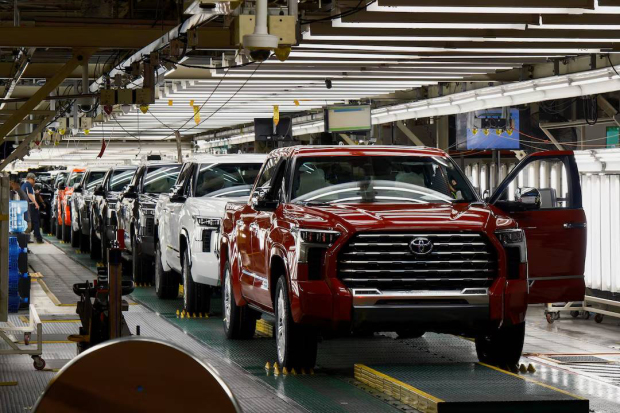
THE Trump administration issued a sweeping demand to Mexico to raise the level of regional content in North American-built cars and trucks to 82 per cent to qualify for preferential trade deal access, with 50pc of that value produced in the United States, four people familiar with the US negotiating stance said on Friday.
The proposed new thresholds were revealed to automakers during two days of bilateral talks to revise the US-Mexico-Canada Agreement on trade that concluded on Friday. Canada was excluded from the negotiations in Mexico City.
There was no provision for counting any parts content from Canada in the revised totals. The shift, if accepted, would be a major break from the current USMCA, which requires 75pc regional content to qualify for preferential tariff treatment.
USMCA also now requires that 40pc of the “core parts” value of North American passenger vehicles be produced in high-wage jurisdictions, effectively the US or Canada. That threshold, covering engines, transmissions, major body parts and EV batteries, is 45pc for pickup trucks.
The US demand and lack of accommodation for Canada are consistent with Trump administration officials’ frequent criticism of Canada’s exports of vehicles and auto parts to the US and requests to move that production to the US.
Auto industry officials said that there was a high likelihood that US Trade Representative Jamieson Greer would seek to negotiate the new rules of origin with Mexico and then present them to Canada as a take-it-or-leave-it proposition. Greer has been evasive about whether USMCA would continue as a trilateral trade pact or be broken into separate bilateral agreements.
USMCA was launched in 2020 to replace the 1994 North American Free Trade Agreement, maintaining a duty-free trade zone that underpins nearly $1.6 trillion in annual trilateral trade.
But President Donald Trump last year imposed 25pc tariffs on Canadian and Mexican vehicles and components, with 50pc duties on steel, aluminum and copper from those countries.
Reuters first reported on Thursday that US negotiators were pursuing a US-specific automotive content requirement.
US trade officials briefed industry lobbyists on the proposal for 82pc regional content, but it was not immediately clear how that figure, or the 50pc US value requirement, would be calculated.
USTR also has proposed raising regional value content for heavy trucks to 75pc from 70pc in the current USMCA, a source familiar with the U.S. proposals said.
The source added that the US also wants to incorporate its stricter calculation method for the local content of high-value components after a dispute panel announced in January 2023 that Mexico and Canada won in a ruling that effectively allows more non-North American parts in those components.
The US trade agency said in a statement that the Mexico City negotiating round also covered steel and aluminum trade and economic security provisions, which are aimed at keeping China and other countries from taking advantage of USMCA.
“The United States concluded discussions with the goals of reducing the trade deficit with Mexico and strengthening American supply chains,” USTR said, adding that both countries will also seek to enhance regulatory compatibility on sectors including medical devices, pharmaceuticals and cosmetic products.
A Mexican official familiar with the negotiations said there were “no surprises” in the Mexico City talks and that there was “not even a hint” of a suggestion from US officials about pulling out of the accord.
USTR said that the US and Mexico will continue their talks on June 16-17 in Washington, D.C., focused on agriculture and “a level playing field.”
USTR has long disputed Mexico’s failure to allow American firms to invest in its state-dominated energy sector.
A third round is scheduled for the week of July 20 in Mexico City, but no talks have been scheduled for Canada.
Greer has said that he intends to keep some level of tariffs on key Mexican and Canadian industrial goods and metals in the revised trade pact. But the two partners may get some preferential tariff rates. Currently, vehicles from Japan, South Korea, the European Union and Britain can be imported at lower rates than those from Canada or Mexico.
&uuid=(email))