

Bahrain’s goal to reduce its carbon emissions by 30 per cent by 2035 and achieve ‘Net Zero’ by 2060 will require the kingdom’s businesses to make their operations more efficient, while offsetting unavoidable emissions with carbon credits, according to a leading sustainability consultant.
Global Carbon Council and International Renewable Energy Certificates (I-RECs) partner Northstar Eco Consult believes this can be done without freezing economic growth or stopping business operations.
“The priority should always be reducing emissions first, with offsetting used responsibly for what cannot yet be avoided,” said Northstar Eco Consult director Deepak Magar.
An organisation’s carbon footprint stems from any business-related operations including running air conditioning, using electricity, driving delivery vehicles or operating machinery.
These operations release invisible greenhouse gases – primarily carbon dioxide – into the air, the total of which become its corporate carbon footprint.
These gases act like a heavy blanket, trapping heat on the surface of the planet, affecting weather patterns.
“For every gramme of carbon gas we release into the air, we must find a way to wipe out or balance an equal amount of carbon,” Mr Magar added.
The first step is to reduce a business’ carbon output.
This can be done by upgrading older, power-hungry appliances to energy-efficient models, switching office lighting to smart LEDs that turn off automatically when a room is empty and using renewable energy whenever possible.
“This not only directly cuts down on utility bills and operational costs, but it also means the company will have a much smaller ‘remaining’ footprint to deal with later,” Mr Magar added.
The second scope of reducing a business’ footprint is offsetting unavoidable carbon output using offsetting.
Purchasing carbon credits produced by eco-friendly projects like Biochar, planting forests, or using renewable energy that either actively absorb carbon dioxide from the air or avoid its production are viable options.
“Every metric tonne of carbon that these projects prevent or remove creates a certified financial asset called a carbon credit,” Mr Magar explained.
“By purchasing and ‘retiring’ these credits, a company can legally and accurately balance its climate ledger to reach a net-zero carbon footprint.”
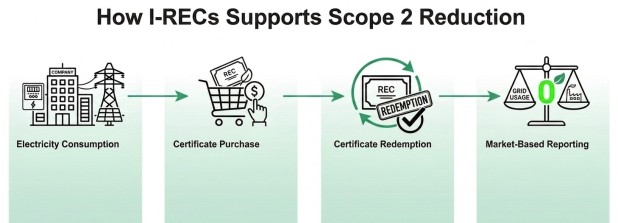
Companies can use International Renewable Energy Certificates (I-RECs) to certify carbon offset measures.
Each I-REC is a digital tracking token that proves exactly one megawatt-hour of electricity was generated from a clean source like a solar or wind farm.
“Because a company cannot always physically pull green electrons straight from the public power grid to its building, it uses these certificates as legal receipts of clean energy ownership,” Mr Magar added.
“The company buys and permanently claims an equivalent number of I-RECs.
“Under international carbon accounting rules, matching grid electricity with I-RECs allows a company to legally report its market-based Scope 2 emissions as zero.
“We work with organisations to measure their carbon footprint, reduce emissions through practical interventions, and use globally recognised tools such as carbon registries and I-RECs to support credible climate action.”
&uuid=(email))