


Primary care physicians (PCPs) in the Muharraq Governorate often rely on clinical judgement when referring patients to plastic surgery, with a first-of-its-kind study highlighting the need for more standardised guidelines.
It also suggested integrating plastic surgery education into PCP training curricula and continuing medical education programmes to improve healthcare in Bahrain.
The study, titled ‘Exploring plastic and reconstructive surgery referral pathways: Insights from primary care physicians in Bahrain’ was conducted by Johns Hopkins Aramco Healthcare (Dhahran) division of plastic surgery’s Abdulla Fakhro, Salmaniya Medical Complex otolaryngology department’s Ali Humood and Hamad General Hospital (Doha) surgery division’s Yusuf Althawadi.
A total of 74 PCPs from all five primary health centres (PHC) within the Muharraq governorate took part in the survey.
“In Bahrain, patients who need specialist care are referred from primary health care centres to secondary facilities,” the study said.
“These facilities include subspecialty clinics such as plastic surgery, otolaryngology, urology, orthopaedic surgery, and general surgery.
“Efficient co-ordination between primary and secondary care is essential to ensure timely referrals, minimise delays and maximise resource utilisation, while poor co-ordination can lead to delays in treatment.
“This study examines Bahraini PCPs’ perceptions of plastic surgery and evaluates current referral practices across all five PHC centres in the governorate.”
Out of the 74 physicians, the majority (77 per cent) were female, with an average age of 46.5, while half were aged between 25 and 34.
In terms of patient volume, half reported seeing more than 50 patients per day. A further 16 PCPs (around 21.6pc) see between 40 and 49 patients daily, 11 (14.9pc) see 30 to 39, two (2.7pc) see 20 to 29 and eight (10.8pc) reported seeing 10 to 19 patients.
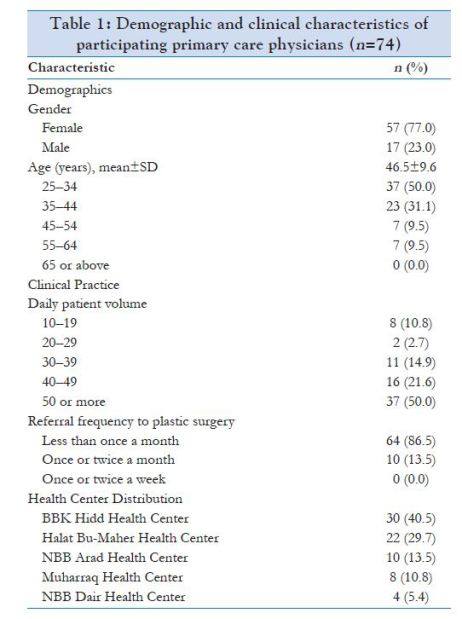
A table from the study showing the demographic of participating PCPs
Most PCPs (30) are based at BBK Hidd Health Centre, followed by 22 at Halat Bu-Maher Health Centre. Ten work at NBB Arad Health Centre, eight at Muharraq Health Centre, and the remaining four at NBB Dair Health Centre.
In terms of referral frequency, a clear majority (64) said they do not typically refer patients for plastic surgery, doing so less than once a month. In contrast, only 10 reported making referrals once or twice monthly.
“Traumatic injuries such as burns, lacerations, and complex wound management constituted the most frequently referred category (63.5pc),” the study revealed.
“This was followed by congenital anomalies such as cleft lip/palate, craniofacial conditions and skin lesions such as moles, cysts, and suspected skin tumours, accounting for 43.2pc.
“Breast disorders, including gynaecomastia, and post‑mastectomy reconstruction, accounted for 33.8pc of referrals.
“Aesthetic concerns such as rhinoplasty, blepharoplasty accounted for 29.7pc, while functional impairments such as hand surgery, nerve repair, and microsurgery represented 12.2pc of cases.”
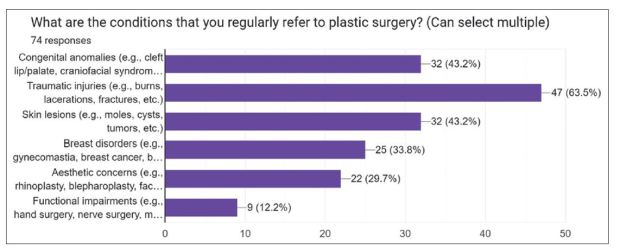
Conditions most commonly referred for plastic surgery
Regarding physicians’ perceptions of plastic surgery, most (67.6pc) recognised it as a vital field capable of transforming lives. However, a notable proportion (33.8pc) viewed it primarily as an aesthetic speciality. Additionally, nine (12.2pc) considered it a supplementary field to dermatology, while an equal number believed it could be replaced by other surgical specialities such as orthopaedics, otolaryngology or general surgery.
The most commonly cited challenge in referring patients for plastic surgery was a lack of clear referral criteria, highlighted by 40 PCPs (54.1pc). Other key issues included limited resources, restricted access to diagnostic tools, a lack of specialised training and time constraints.
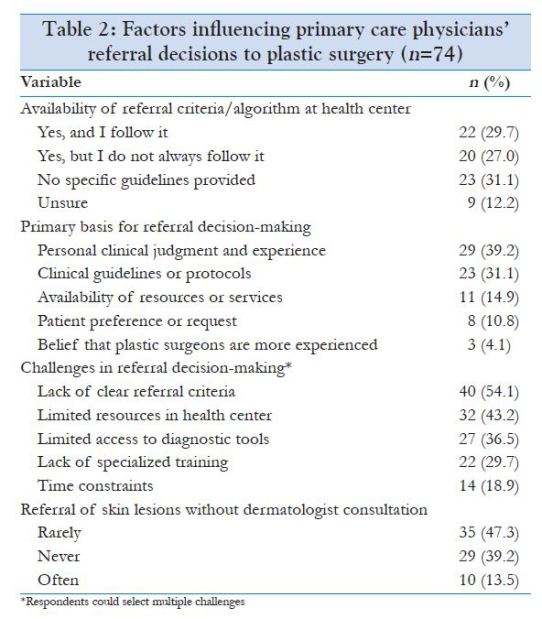
Factors influencing referral to plastic surgery
Most referrals (29 PCPs) were based on personal judgement rather than standardised processes. Meanwhile, 23 PCPs said they followed clinical guidelines or protocols, 11 said decisions depended on the availability of services, eight cited patient preference, and only three considered the surgeon’s experience.
The study concluded by stating that PCP referral practices to plastic surgery in Muharraq Governorate lack standardised guidelines and frequently rely on personal clinical judgement.
The absence of clear criteria was identified as the primary challenge, with findings suggesting current practices may lead to inappropriate referrals – both unnecessary and misdirected – with implications for healthcare costs and resource allocation.
“Based on these findings, we propose the development and distribution of evidence‑based plastic surgery referral algorithms across all centres,” the study said.
“Second, the integration of plastic surgery education into PCP training curricula and continuing medical education programmes.
“Third, the establishment of structured communication channels between PCPs and plastic surgeons to facilitate appropriate consultations. “Finally, regular audits of referral patterns to monitor quality and identify areas for ongoing improvement.”
nader@gdnmedia.bh
&uuid=(email))