

IRAQ’S Oil Ministry said yesterday that Opec has begun gradually restoring Iraq’s pre-war production allocations, a move it said would strengthen Iraq’s output capacity and support recovery of its oil sector.
In a statement carried by the state news agency, the ministry said Baghdad supported a reassessment of Opec production quotas to better reflect member states’ conditions, including Iraq’s economic and security circumstances.
Iraq’s Prime Minister Ali Faleh Al Zaidi had not discussed the possibility of Iraq leaving Opec, the statement added.
On Thursday, sources with knowledge told Reuters that Iraq, Opec’s second-largest producer after Saudi Arabia and one of its five founding members, has considered leaving the group if the oil producer group does not allow Baghdad to significantly increase oil production.
Such prospect would be a serious blow to the Organisation of the Petroleum Exporting Countries, which saw the United Arab Emirates walk away less than two months ago.
The country relies on oil for the bulk of its income, which has been slashed since the Iran war effectively blocked exports via the Strait of Hormuz.
Later on Thursday, Iraq’s oil ministry said that reports suggesting Baghdad was considering ending its membership in Opec did not reflect the Iraqi government’s official position.
Iraq’s quota for July is 4.378 million barrels per day though current output is significantly below this because of the Hormuz disruption.
Meanwhile, Saudi Aramco resumed crude loadings yesterday at its Ras Tanura terminal in the Gulf after a near four-month halt, shipping data showed, as the world’s biggest oil exporter joined a rush to move cargoes amid industry hopes of a return to normal.
The Saudi oil loadings come even though a ship belonging to Taiwan’s Evergreen Marine was hit by an unknown object in the Strait of Hormuz on Thursday.
Middle Eastern producers had been ramping up oil and gas output and exports in the lead-up to the interim deal between the United States and Iran to halt the war and reopen the strait where a fifth of the world’s oil and liquefied natural gas supplies used to pass.
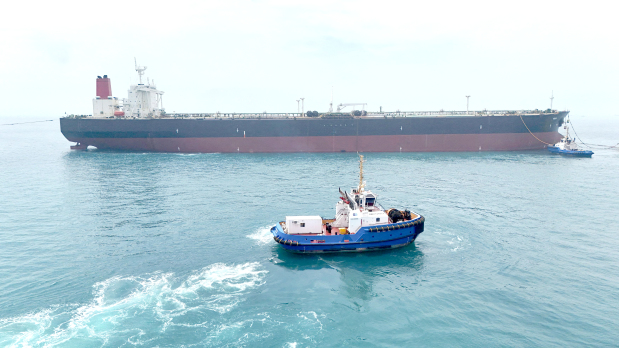
Two Very Large Crude Carriers controlled by Saudi’s shipping arm Bahri were seen loading crude at Ras Tanura, the world’s biggest oil port, while another waited nearby, the data showed. Each VLCC is capable of loading 2 million barrels of oil.
Ras Tanura sits on Saudi Arabia’s eastern coast on the Gulf and is west of the Strait of Hormuz. It used to export more than 5m bpd of crude before the conflict. The country’s largest domestic 550,000 bpd refinery is also located at Ras Tanura, which was shut during the war as a precautionary measure.
&uuid=(email))