

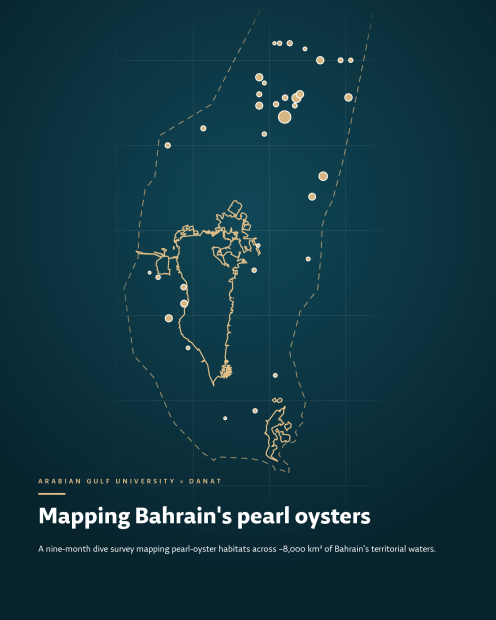
Researchers from the Arabian Gulf University (AGU) and the Bahrain Institute for Pearls and Gemstones (Danat) have completed an 11-month survey of Bahrain’s marine waters to map pearl oyster beds and seagrass habitats, creating what is expected to become one of the kingdom’s most comprehensive marine databases.
Covering more than 8,000 square kilometres, the project aims to protect Bahrain’s pearl heritage, conserve marine ecosystems and assess the carbon storage potential of seagrass habitats, known as ‘blue carbon’, to support the kingdom’s environmental and climate goals.
The findings were announced during the launch of Danat’s 2025 Sustainability Report, the release of its 2025 Greenhouse Gas (GHG) Emissions Report and the unveiling of the Hayrat Project Initiative.
Samples collected during the survey from May last year to April 2026 are now being analysed by specialists, with the findings expected to guide future marine conservation and environmental policymaking.
AGU Geographic Information Systems and Environment Associate Professor Dr Sabah Al Junaid said the research covered three main marine zones around Bahrain, with periodic samples collected.
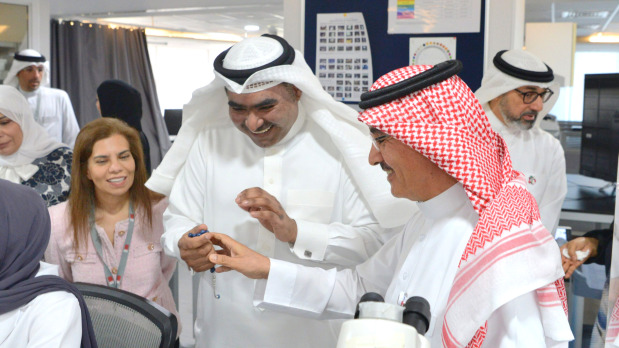
AGU delegation during the Danat visit to advance ‘Blue Carbon’ research and natural pearl studies earlier this year
“The data is now being anaylsed using remote sensing and advanced environmental mapping technologies,” she said.

Dr Al Junaid
“Danat experts are identifying the species and density of pearl oysters to build an accurate scientific database on the condition of Bahrain’s marine habitats.”
Dr Al Junaid said one of the project’s key objectives is to measure how much carbon is absorbed and stored by these ecosystems.
Seagrass habitats contribute to what is known as blue carbon, the organic carbon captured and stored by oceans and coastal ecosystems. Such habitats help remove carbon dioxide from the atmosphere and store it naturally over long periods.
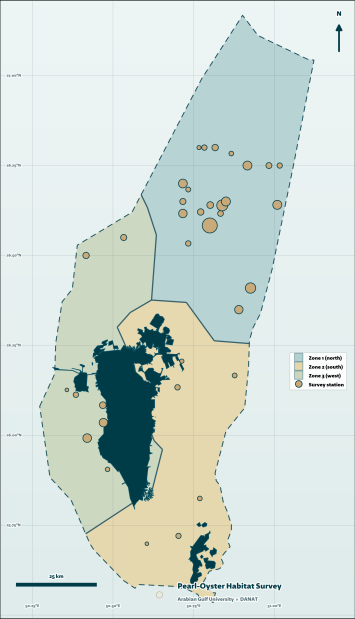
A map showing the different zones where the research took place
Dr Al Junaid, who is also an academic supervisor of the Shaikh Hamad Bin Khalifa Al Thani Chair in Geographic Information Systems, added that the research will support Bahrain’s commitments under the Paris Climate Agreement by promoting nature-based solutions to reduce greenhouse gas emissions.
Beyond environmental conservation, the project is expected to establish a national scientific database and develop specialised Bahraini expertise that government agencies can draw upon for future environmental studies, policymaking and marine resource management.
“The project demonstrates the value of collaboration between national and research institutions and reflects Bahrain’s commitment to protecting its marine environment, preserving its pearl heritage and promoting environmental sustainability for future generations,” she said.
Danat released its 2025 Sustainability Report, together with its 2025 GHG report and the Hayrat Project Initiative last week, marking a new step in the institute’s efforts to advance environmental responsibility and support the conservation of Bahrain’s natural pearl oyster beds.
It outlines its progress across environmental, social and governance areas, with a focus on climate management, marine biodiversity, pearl oyster research, blue carbon studies, resource efficiency, education, outreach and responsible operations.
According to the report, the institute’s greenhouse gas emissions totalled 313.43 tonnes of carbon dioxide equivalent (tCO₂e) in 2024, representing a 21.7 per cent reduction compared with its 2022 baseline.
It also notes that Danat has tested more than 32 million pearls and gemstones since its establishment in 2017.
Danat, a wholly owned subsidiary of Bahrain Mumtalakat Holding Company, serves as Bahrain’s national authority for pearl and gemstone testing and certification while supporting research into the kingdom’s natural pearl heritage.
julia@gdnmedia.bh
&uuid=(email))