

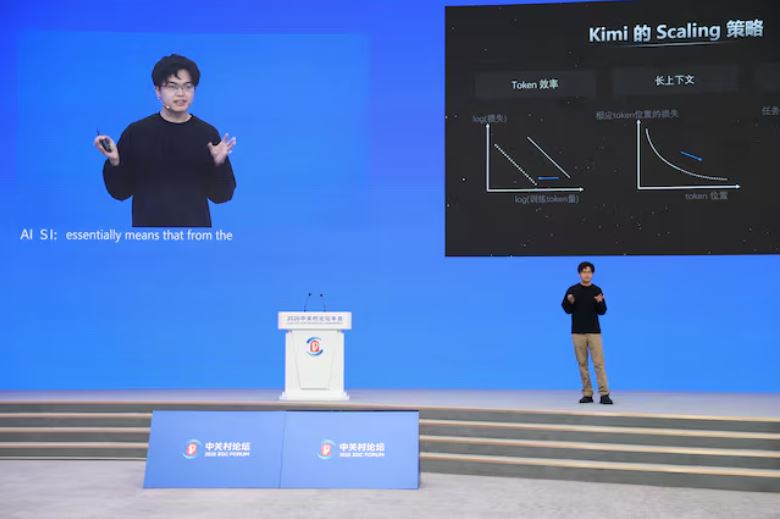
Chinese AI startup Moonshot yesterday unveiled Kimi K3, a 2.8 trillion-parameter model that it said is the world’s largest open-weight AI system and delivers performance approaching US giant Anthropic’s frontier Fable model.
The launch, which comes a month after Anthropic’s Fable and Mythos models were abruptly withdrawn by the US government due to security concerns, underscores how quickly China’s open AI ecosystem is narrowing the gap with the most advanced US systems.
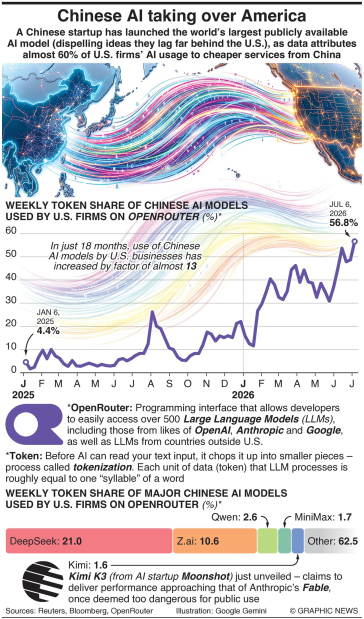
Companies including Moonshot, Z.ai and MiniMax are releasing increasingly powerful models at sharply lower cost, challenging long-held assumptions in the West that Chinese developers trail their American peers by months.
Moonshot said Kimi K3 is the first open-weight model to approach the 3trn-parameter mark and is designed for advanced reasoning, long-horizon coding and knowledge work.
The model features a 1 million-token context window, allowing it to process and retain substantially more information than earlier generations in a single prompt.
Open-weight models allow users to download, run and customise the underlying systems, unlike proprietary, closed-source models.
Kimi K3 “performed competitively with Fable 5 (with fallback) and substantially outperformed Anthropic’s Opus 4.8, GPT 5.6 Sol, and GPT 5.5” in terms of GPU kernel optimisation, the company said.
The term refers to techniques that maximise AI hardware utilisation and minimise latency.
The model has also posted strong results in third-party evaluations.
Arena.ai ranked Kimi K3 first in a benchmark assessing web interface-building capabilities, while Vals AI placed it second overall behind Fable 5 and ahead of GPT-5.6 Sol. Artificial Analysis said the model delivered performance comparable to OpenAI’s GPT-5.5 and Anthropic’s Claude Opus 4.8, particularly on tests measuring complex, multi-step tasks.
The Moonshot news drove shares of domestic AI competitors Zhipu and Minimax down sharply in Hong Kong; just before market close, they were down 27.7 per cent and 16.5pc, respectively.
Chinese AI firms are accelerating their model release cycles as the global AI race intensifies.
The shift follows the debut of Z.ai’s GLM-5.2, which stunned industry observers by scoring near top US closed-source models on benchmark tests, undermining a consensus among Western analysts that Chinese AI models were at least six months behind.
Lian Jye Su, chief analyst at Omdia, said Chinese models were gaining traction because they could be deployed far more cheaply than leading US systems.
&uuid=(email))