

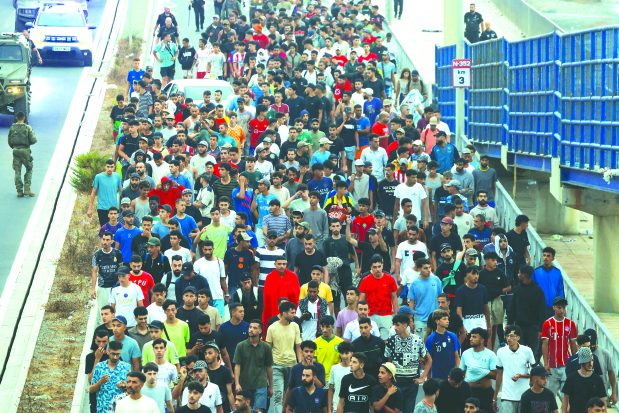
Spain has condemned the ‘selfish, polarising and unlawful’ reaction of some EU countries to the influx of about 60,000 migrants from Morocco into the Spanish enclave of Ceuta.
Spanish officials say almost all those who reached Ceuta on July 30 have returned, while Spain’s interior minister said yesterday that the death toll from the surge in crossings had risen to at least 86.
Italy temporarily suspended the EU’s border-free Schengen arrangement with Spain, as Prime Minister Giorgia Meloni called the scenes ‘shocking’.
Finland and Denmark backed Italy’s move, while Czech Prime Minister Andrej Babis urged a temporary suspension of Spain’s Schengen membership.
EU interior ministers will meet on Tuesday by video conference to discuss the issue.
Spanish Prime Minister Pedro Sanchez had called for an urgent meeting to ‘reaffirm that the security of our external borders is a shared responsibility of all member states’.
Twenty-two of the EU’s 27 countries also called for emergency talks in an open letter, citing ‘serious concerns’ regarding the developments in Ceuta.
In a letter to European Commission President Ursula von der Leyen, Sanchez said he had ‘serious concerns’ about some European governments.
He said the Spanish government had fully restored control over the border and prevented any ‘unauthorised onward movement towards continental Europe’ in less than 48 hours.
While most had shown ‘support and solidarity’, Sanchez said other European governments had chosen to attack Spain, ‘driven by prejudice, fake news, ignorance, or political interest’, and pointed out that Ceuta was not part of the Schengen area.
“The European Union cannot afford this kind of selfish, polarising and unlawful reaction,” he said.
Also yesterday, UK Prime Minister Andy Burnham said he had spoken to Sanchez and the UK was ‘providing what help we can’.
There were chaotic scenes on Thursday in Ceuta as border controls in the North African enclave apparently broke down.
But in a news conference yesterday, Spain’s Interior Minister Fernando Grande-Marlaska told reporters the situation in Ceuta had almost returned to normal.
“Almost all of (the migrants) have already left Ceuta,” the minister said, adding that businesses had now reopened.
“The situation has been almost entirely reversed.”
He also said Spain had started to establish an inflatable maritime barrier to prevent further illegal migrant entry.
But while the situation on the ground appears to be easing, political and diplomatic fallout is rippling through Madrid and other capitals.
On Thursday, Italy’s Prime Minister Giorgia Meloni wrote on social media that such ‘uncontrolled immigration’ was a threat to national security, before suspending the Schengen zone agreement with Spain for a month.
The Schengen Area is a system of open borders spanning 29 European countries that have abolished controls at their common borders.
Spain responded by summoning the Italian ambassador to Madrid, while its foreign minister said he expected ‘European solidarity and not partisan demagoguery’.
Finland’s Interior Minister Mari Rantanen said she had started preparations for restoring internal border checks ‘if the need arises’.
She also urged ‘all European countries’ to support Meloni’s move.
Danish Prime Minister Mette Frederiksen also urged the EU to ‘consider all options, including a suspension of Schengen co-operation’.
France has tightened checks on its border with Spain and said it would increase its police presence.
&uuid=(email))