

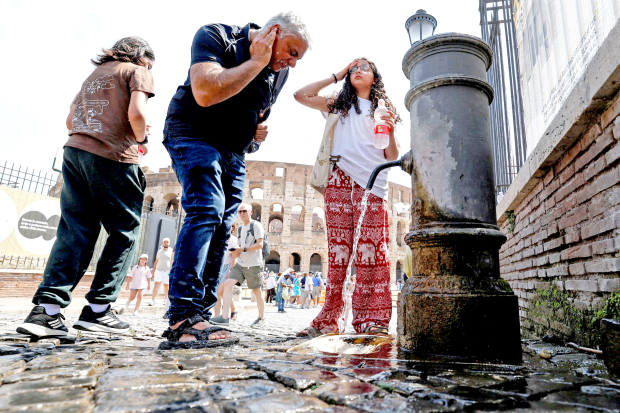
Italy is placing all its 27 major cities under its highest heat alert tomorrow, as the country’s fourth heatwave of the summer intensifies, the health ministry said yesterday.
Twenty-five cities were put on red alert yesterday and today, with the only two currently on a lesser amber alert, Messina and Reggio Calabria in the far south of the country, moving up to the maximum level tomorrow.
A red alert indicates a potential health emergency with prolonged high temperatures posing a serious health risk to the entire population, including young and healthy people.
Local authorities urged residents in affected areas to avoid exposure to heat and direct sunlight during the hottest hours of the day, between 11am and 6pm, stay indoors where possible and drink plenty of fluids.
A spokesperson at the health ministry said it was the first time this year that all 27 cities had been issued with a red alert, but could not confirm if this had ever happened in previous years.
Temperatures have climbed to 40C in some areas of Italy and little relief is expected before the weekend.
Forecasters say the heatwave is being fuelled by a North African anticyclone that has strengthened over the Mediterranean and stretched across much of Europe.
Despondent residents returned to gutted homes and fire-scarred landscapes northwest of Athens yesterday as wildfires eased across Greece, though hundreds of firefighters were on alert for persistent flare-ups in rugged hills and canyons across the country.
Local crews supported by water-bombing aircraft and reinforcements from Romania and France were operating on three fronts west of Athens around the Gulf of Corinth, dousing flames raging since Friday.
Strong dry winds blowing from the Aegean Sea, known as the meltemi, had complicated their efforts, with water bombers unable to operate at times, officials said.
“We are talking about a fire where we didn’t have an aircraft at our disposal for 30 continuous hours, which caused us a lot of difficulties,” deputy fire brigade spokesperson Ioannis Artopoios told public broadcaster ERT.
In the coastal community of Porto Germeno, 60km northwest of Athens, Vivi Gialia, 45, surveyed the remains of her parents’ home and the fire-ravaged landscape of her childhood summers.
“It’s as if my heart has been torn out,” she told Reuters. Europe has been ravaged by wildfires this summer after a period of record-breaking heatwaves and little rain – conditions that many scientists say have been exacerbated by human-driven climate change.
France and Spain have been particularly hard hit, although huge blazes there died down over the weekend, providing some respite.
Greece, a known fire hotspot, had until now experienced a relatively mild summer.
Two crew members of a firefighting helicopter died on Sunday near the seaside community of Psatha, 40km from Athens, after a mid-air brush with a second helicopter, whose two crew survived.
The circumstances of the crash, which involved US-registered Bell helicopters, were under investigation by the US Federal Aviation Administration, Greek authorities said.
The fire, possibly caused by sparks from vibrating electricity conductors, occurred in an area popular as a retreat for Athenians.
More than 200 companion and farm animals rescued by volunteers were housed at a shelter in the town of Megara west of Athens.
&uuid=(email))