

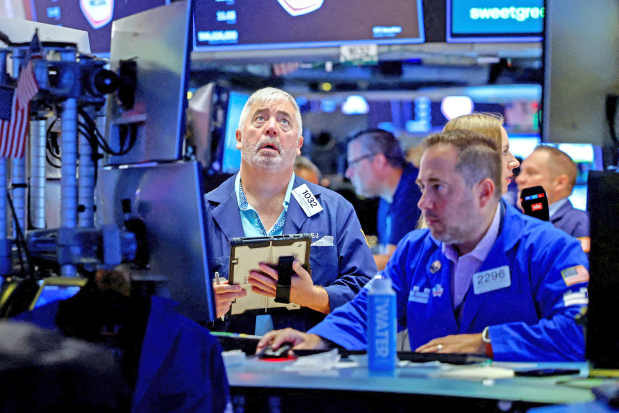
US stocks were mixed yesterday and the dollar fell to its lowest level since June, after a run of soft US economic data, including an unexpected drop in retail sales, led markets to scale back bets on an imminent Fed rate move.
Thirty-year Treasury yields, meanwhile, climbed to their highest level since 2007, as concerns over the US fiscal trajectory combined with heavy AI-related corporate debt issuance to push yields higher. The S&P 500 fell 0.11 per cent while a strong revenue forecast from AI lab Anthropic gave the Nasdaq Composite a 0.08pc lift. The Dow Jones Industrial Average fell 0.21pc.
MSCI’s gauge of stocks across the globe was flat on the day, while the pan-European STOXX 600 Index fell 0.06pc.
Concerns over the payoff from AI investment have battered chip stocks in recent weeks, but robust quarterly results and upbeat forecasts pointing to resilient demand have pushed the tech-heavy Nasdaq back toward record territory.
“People are seeing where money is being spent, where the returns are coming from... and those things mean the immediate concern about a potential AI boom then bust is waning somewhat,” said Danni Hewson, head of financial analysis at AJ Bell.
Earnings are lighter this week but include reports from Home Depot, Target and Walmart, which investors will watch closely for signs of consumer strength.
The key data release is August’s S&P Purchasing Managers’ Indices (PMIs), which will show whether the mid-year pickup in US business activity is holding up. The dollar slipped as traders pushed back their expectations for the Fed’s next move. Benign consumer and producer price inflation data for July, released last week, boosted hopes that the worst of the price pressures may be behind us – even as uncertainty over the Iran conflict lingers. An unexpected drop in retail sales last month added to concerns that the US economy may not be as resilient as previously thought.
The dollar index, which measures the greenback against a basket of currencies including the yen and the euro, fell 0.17pc to 99.42, with the euro up 0.22pc at $1.1595.
Markets are now pricing just a 31pc chance of a Fed move next month, down from about 55pc a week earlier, while the odds of a move by December stand at 66pc. Oil prices rose yesterday on a lack of progress in diplomatic efforts to resolve the Iran war, though the absence of major supply outages limited gains. Iran has decided to shift its policy from defensive to “fully offensive” due to the deadlock in efforts to agree a permanent end to its war with the United States, a senior Iranian official told Reuters yesterday.
US crude rose 0.12pc to $82.50 a barrel and Brent rose to $88.85 per barrel, up 0.36pc on the day.
Treasury yields, meanwhile, gained after the US government also had to pay the highest rates for a sale of 30-year bonds at an auction last week since 2001.
The yield on benchmark US 10-year notes rose 0.41 basis points to 4.7pc. The 30-year bond yield rose 1.24 basis points to 5.2784pc and reached 5.29pc, the highest since 2007.
“Three soft economic releases should have pushed long-end yields lower. Instead, 30-year bonds were auctioned at the highest yield since 2001, and yields are now even higher. A worsening fiscal outlook, AI-driven corporate duration supply, and a more price-sensitive buyer base help explain why,” Barclays Capital analyst Anshul Pradhan said on Monday in a note.
In precious metals, spot gold rose 0.78pc to $4,409.94 an ounce.
l Bahrain All Share Index has closed at 1,951.60 points, marking a decrease of 0.88 points below the previous closing. This decrease was due to a drop in the financials sector and the materials sector.
Bahrain Islamic Index closed at 928.91 points, marking an increase of 1.35 points above the previous closing.
Results indicated that 83 equity transactions took place with a volume of 1,410,267 worth BD 469,125.
Investors traded mainly in the financials sector, representing 87.65pc of the total value of securities traded.
&uuid=(email))