

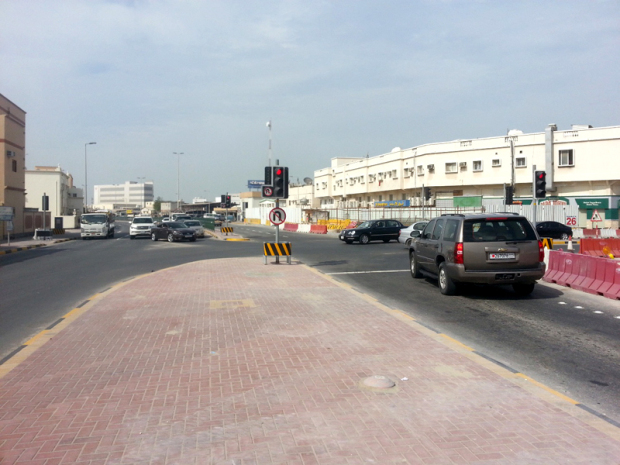
Bahrain’s traffic lights could be due for a technological makeover, with municipal officials calling for a smarter system that can respond to traffic conditions instead of forcing motorists to wait through fixed signal timings.
Capital Trustees Board chairman Saleh Tarradah said the current system often fails to reflect the actual flow of traffic, leaving one road packed with vehicles while another direction has little or no traffic.
He said fixed intervals between signals, including 30-second cycles in some locations, can create unnecessary congestion and frustrate motorists. Under the current system, traffic lights blink green five times before turning yellow and then red.
“Thirty seconds may mean heavy traffic in one direction and barely any traffic in another,” Mr Tarradah said. “The traffic light should be able to recognise the situation and respond accordingly, rather than treating every direction in exactly the same way.”
He also questioned the need for a five-second flashing phase at certain signals where there is no apparent need to provide motorists with an extended warning before the lights change.
Mr Tarradah believes Bahrain should move towards intelligent traffic signals capable of detecting traffic volumes in real time and automatically adjusting signal timings.
“We need smart traffic lights that recognise traffic volumes, similar to the new AI-powered cameras being used for traffic violations,” he said.
Such a system, he argued, could help reduce unnecessary queues, improve journey times and make better use of existing roads without requiring major infrastructure expansion.
It could also reduce the pressure on traffic officers, who are frequently deployed at busy junctions to manually regulate vehicle movement when congestion becomes severe.
“Our traffic policemen should not have to stand in the heat simply because the traffic lights cannot respond to changing traffic conditions,” Mr Tarradah said. “Technology should help them, not leave them to manually control traffic or adjust traffic lights that could be managed automatically.”
Mr Tarradah said the objective was not simply to change traffic-light timings, but to introduce a system capable of thinking with the traffic.
“Drivers should not be waiting at a red light when there are no vehicles coming from the other direction,” he said. “If we already have artificial intelligence being used to detect traffic violations, we should also use smart technology to manage traffic itself.”
The proposal has received backing from Capital Trustees Board vice-chairwoman Dr Khulood Al Qattan, who said traffic management should keep pace with Bahrain’s rapid development and growing number of vehicles.
Dr Al Qattan believes a modern traffic system should be based on actual road conditions rather than relying solely on pre-programmed timings.
“We need to look at traffic lights as part of a wider smart-city system,” she said. “Technology can tell us where congestion is building, where traffic is moving freely and where signal timings need to be changed.”
She said intelligent signals could potentially communicate with other traffic-management systems and provide authorities with real-time information to respond more quickly to bottlenecks.
The municipal officials believe the issue deserves a comprehensive review involving the Capital Trustees Board, the General Directorate of Traffic and other relevant authorities.
The call comes as Bahrain continues to expand its smart-government and artificial intelligence capabilities, raising the prospect of roads where traffic signals adjust dynamically to congestion rather than motorists having to adjust to the clock.
According to the Works Ministry data for 2014 the total number of intersections controlled by traffic signals in Bahrain amounted to 321.
mohammed@gdnmedia.bh
&uuid=(email))