

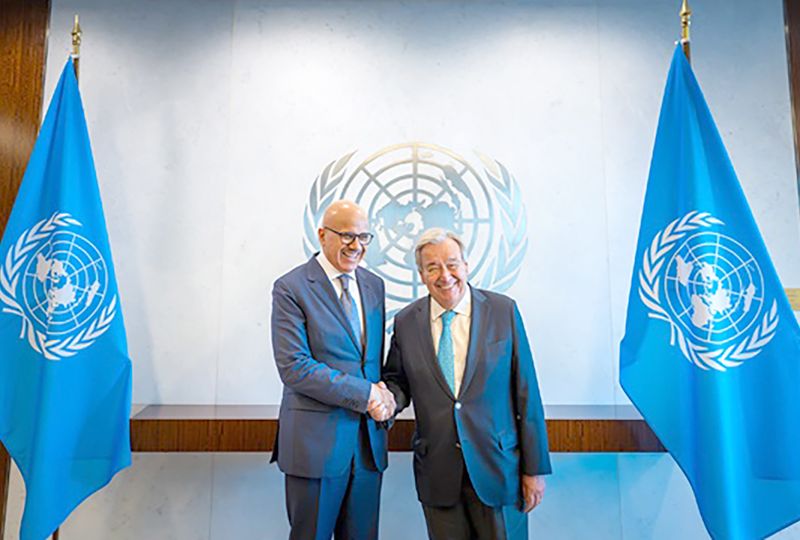
Foreign Minister Dr Abdullatif Al Zayani while delivering Bahrain’s statement at the Arria-formula meeting of the UN Security Council, highlighted a dimension that he said had not received sufficient attention in international discussions: the costs of disruption to maritime routes are not distributed equally.
“Economically stronger countries pay more but remain able to continue, while developing economies pay more and then come to a halt,” he said.
Higher shipping costs and insurance premiums directly affect food, medicine and fuel prices, he noted, while disruptions to grain and fertiliser routes affect food security in the Horn of Africa, East Africa and South Asia.
Small island developing states and landlocked countries often depend on a single route, meaning that disruption can result in a break in supplies rather than simply higher costs.
He also noted that the vast majority of the world’s seafarers come from developing countries and bear the direct human costs of such disruptions.
Dr Al Zayani stressed that maritime security is as much a development issue as it is a security issue, adding that any approach that does not involve the countries most affected and those with the least voice would remain incomplete.
More than 50 speakers took part in the meeting. Briefings were delivered by Dr Rania Al Mashat, UN Under-Secretary-General and Executive Secretary of the Economic and Social Commission for Western Asia (ESCWA); Pedro Manuel Moreno, Deputy Secretary-General and Acting Secretary-General of the UN Conference on Trade and Development (UNCTAD); Beate Andrees, Deputy Director-General of the International Labour Organisation (ILO); Thomas Kazakos, Secretary-General of the International Chamber of Shipping; and Professor Christian Bueger of the University of Copenhagen and the UN Institute for Disarmament Research.
The main speakers stressed that maritime insecurity does not remain confined to the sea, as vital maritime routes are shared arteries of international security and prosperity. Energy, food and essential goods are transported through these routes, accounting for more than 80 per cent of global merchandise trade.
Moroccan Foreign Minister Nasser Bourita praised Bahrain’s role as a maritime hub and highlighted the international impact of violations in the Strait of Hormuz and Bab Al Mandab on navigation in different parts of the world.
UAE Minister of State for Foreign Affairs Khalifa Shaheen Al Marar stressed the need to ensure the uninterrupted security and protection of supply chains, trade and energy, emphasising the importance of supporting all efforts to de-escalate tensions and ensure the security, stability and prosperity of the countries of the region.
&uuid=(email))