

.jpg?20261003')
Tougher regulations are being urged to tackle rising childhood obesity in Bahrain, with health experts warning that more than 40 per cent of children in the kingdom are overweight.
Medics are calling for tighter controls on the marketing and sale of unhealthy products, healthier food environments in schools, pricing measures linked to sugar content and clearer, easier-to-understand food labels.
The call came during the second Bahrain Diabetes and Obesity Conference, which kicked off yesterday at the Diplomat Radisson Blu Hotel, Residence and Spa under the theme ‘Shaping Healthier Futures’.
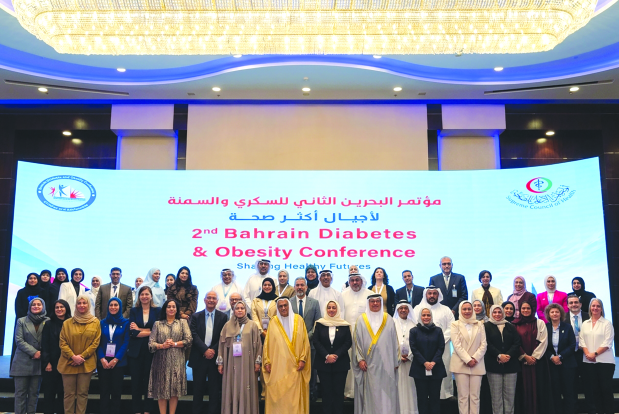
Officials and speakers during the opening ceremony
The forum brought together experts, researchers and healthcare professionals from Bahrain and abroad to discuss the latest advances in the prevention, diagnosis, treatment and management of diabetes and obesity.
Supreme Council for Health chairman Lieutenant-General Dr Shaikh Mohammed bin Abdulla Al Khalifa attended the opening ceremony, highlighting the importance of investing in children’s health in a video message played at the event. Also present was Health Minister Dr Jalila Al Sayyed.
Addressing the factors contributing to rising childhood obesity, public health physician and epidemiologist Dr Ibtihal Fadhil said stronger action was needed to protect children from an environment that increasingly promotes unhealthy choices.
“The figure of 40pc of children being overweight in Bahrain is a huge public health concern, and if we are going to work to decrease this number to five or 10pc, we need to think outside the health system and reach them before obesity develops and increases the risk of diabetes,” she said during her presentation.
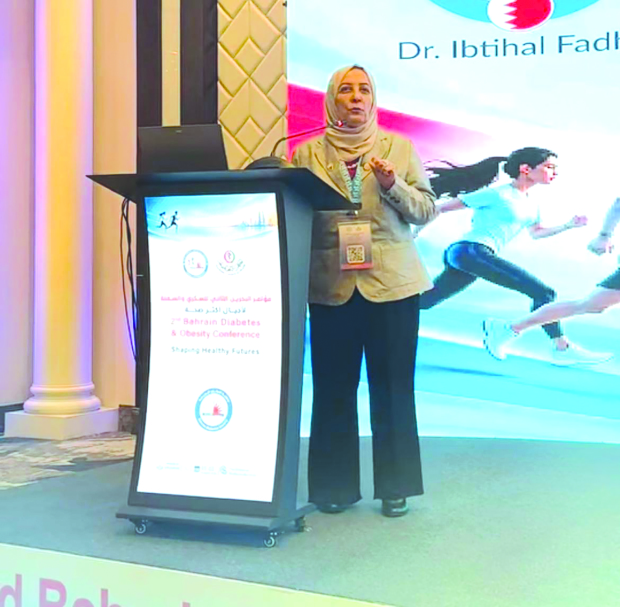
Dr Fadhil speaking at the conference yesterday
Dr Fadhil said children were being encouraged to adopt healthy lifestyles while surrounded by unhealthy choices at school, online, through gaming and on television.
“Can we really blame children for making unhealthy choices?” she asked. “Young people are constantly exposed to an environment that can negatively influence their choices.”
“For example, if a child has to choose between healthy and unhealthy food, they will most likely choose the unhealthy option.”
While education remains important, Dr Fadhil stressed that it was not enough on its own to help families make healthier choices.
“We need to regulate marketing and products,” she said, pointing to measures introduced in the UAE, where sweetened drinks are subject to a tiered volumetric excise tax based on their sugar content.
The UAE applies an excise tax on sweetened drinks ranging from AED 0.79 to AED 1.09 per litre based on sugar content, replacing the previous flat rate of 50 per cent.
Dr Fadhil also called for clearer and simpler food and nutrition labels so parents and children can easily understand the nutritional content of products.
“Parents and families shouldn’t need a degree in nutrition to read a label; it should be simple.”
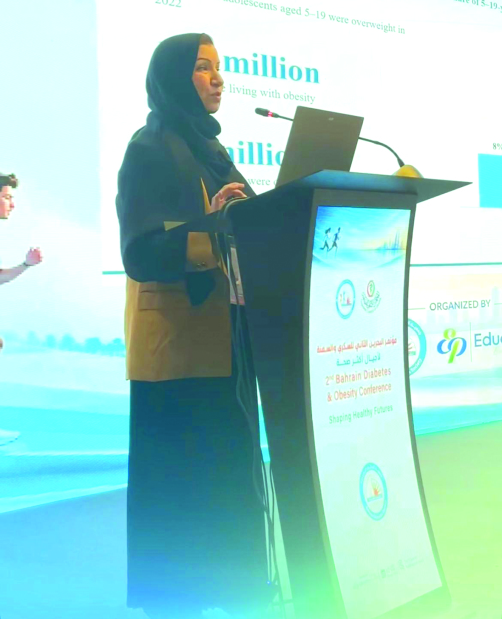
Prof Alkhayyat speaking during her presentation
Meanwhile, Bahrain Defence Force paediatric department head Professor Haya Alkhayyat said 43pc of Bahraini children aged 12 to 15 were overweight or obese, with boys accounting for 24.3 per cent and girls for 20.8 per cent.
She added that more than a third of children and adolescents aged five to 19 in Bahrain were overweight, placing the kingdom within a region identified as a ‘hotspot’ in the Global Burden of Disease forecast.
Prof Alkhayyat warned that, without stronger preventive measures, more than 120 million children worldwide could show signs of chronic disease linked to a high body mass index (BMI) by 2040.
“Obesity has complications that affect every organ system,” she warned. “There are metabolic problems, insulin resistance and pre-diabetes. These used to be considered adult diseases, not paediatric diseases, but our clinics are now full of children with these conditions.”
She stressed that tackling childhood obesity requires a comprehensive approach that goes beyond individual lifestyle choices.
“To prevent these diseases, we need a comprehensive approach, with policy and environmental changes, sugary-drink taxes, marketing restrictions, food labelling, healthy meals in schools, less screen time and more sleep,” she said.
Prof Alkhayyat also recommended reducing sugary drinks, prioritising whole foods and ensuring children get at least 60 minutes of physical activity a day.
She advised against screen time for children under two, limiting it to one hour a day for those aged two to four, and avoiding screens during meals and in the bedroom.
The conference concludes today with sessions covering a range of topics, including the transition from paediatric to adult diabetic clinics, family-based interventions for adults with type 2 diabetes and cardiovascular risk reduction in diabetes.
julia@gdnmedia.bh
&uuid=(email))