

Environmental researchers are calling for strong monitoring of microplastics to protect and ensure the long-term survival of Bahrain’s mangroves, in a recently published study.
The ‘Microplastics Contamination and Ecological Risk Assessment in Natural and Afforested Mangrove Stands of Bahrain: Abundance, Polymer Composition, and Onshore-Offshore Variability’ study was conducted by an international team of researchers from Türkiye and Bahrain and published in the peer-reviewed, open access Toxics academic journal.
“Mangrove ecosystems are ecologically important coastal habitats, yet data on microplastic contamination along Bahrain’s coasts remains scarce,” researchers noted in the abstract of the study.
“Although ecological risk indices suggested an overall low-to-moderate environmental risk, the ubiquitous occurrence of ‘MPs’ throughout Bahrain’s mangrove sediments raises concern regarding their long-term ecological implication.
“These findings provide a robust baseline for future spatiotemporal monitoring, refined ecological risk assessments, and the formation of targeted management strategies to safeguard coastal ecosystems.”
The research team comprised Zeynep Kilinc and Gamze Yesilay from the University of Health Sciences-Turkey in Istanbul, as well as Abdulkarim Rashed, Reem AlMealla, Batool Ahmed, Sakina Mustafa, Ahmed Khamis, Khalil Abdulla and Layla Hazeem from Bahrain.
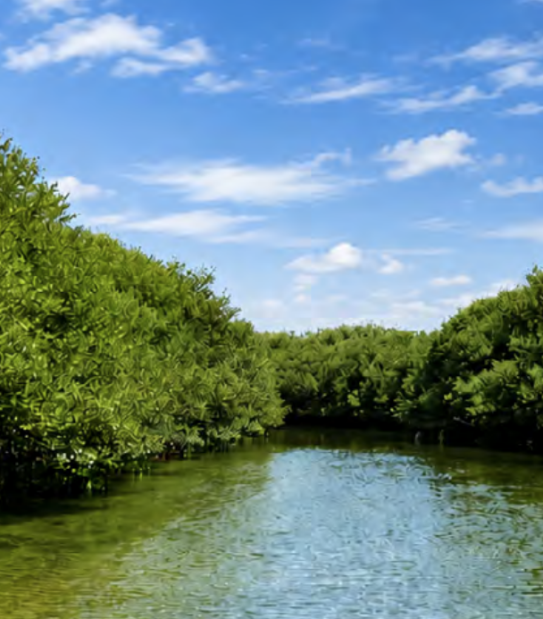
Bahrain earlier this year surpassed its mangrove planting milestone ahead of the 2035 deadline
Researchers collected sediment samples from 12 stations across four mangrove sites in Bahrain, testing for abundance, characteristics and ecological risks.
Microplastics were detected at all stations, with black fragments being the dominant colour and shape.
Researchers also found microplastics that were smaller than the current monitoring threshold in mangrove systems across the Arabian Gulf, which had not been previously sampled.
“The occurrence of microplastics in mangrove ecosystems presents an essential, environmental concern that affects the sediment structure, disrupts biological communities, and facilitates the accumulation and transfer of toxic contaminants, thus challenging essential mangrove ecosystem functions,” researchers noted.
The highest concentration of microplastics was recorded at the offshore afforested site Fasht Al Jarim, which researchers attributed to regional transport, including tidal currents, sea-water circulation and fishing rather than direct local human activity.
The second-highest concentration was found in the protected natural mangrove site Ras Sanad. Researchers attributed microplastic presence here to the plastic waste nearby, as well as human activity in the area.
The third-highest concentration of microplastics was recorded in Tubli Bay, with researchers noting that migratory and resident wading birds which feed and rest in the area might inadvertently add to microplastic concentration through their fecal matter.
Arad Bay showed the lowest concentration of the four studied sites, which researchers said, could be ‘attributed to regulated waste disposal and environmental management practices associated with its protected status.’
At every sampling site, researchers found Nylon-6, a tough synthetic polymer commonly used in fishing nets, ropes, fishing lines and synthetic textiles.
The team noted that Bahrain’s afforestation efforts, while successful, must be paired with effective microplastic monitoring and control at the source of plastic pollution, to be effective.
“Bahrain’s restoration efforts, the Bahrain Mangroves Initiative and National Afforestation Strategy, which aim to quadruple mangrove coverage by 2035 as part of the kingdom’s 2060 carbon-neutrality commitment, sit within a broader context of strengthened environmental governance and cross-sector partnership,” they noted. “However, these sustainability gains cannot be fully realised while microplastic pollution accumulates unchecked – microplastic contamination has been shown to shift mangrove sediment microbial communities towards methanogenic pathways at the expense of blue-carbon storage, impair root oxygen and nutrient uptake and thus growth, and raise concerns for fisheries productivity and food security through trophic transfer.
“Our detection of Nylon-6 and other polymers across both natural and afforested sites shows that afforestation alone does not confer protection from plastic contamination, underscoring the need to pair large-scale planting with explicit monitoring and source control.”
In addition to monitoring, researchers recommended clear institutional ownership, a defined sampling protocol and measurable intervention thresholds, so that restoration translates into ecological resilience rather than coverage alone.
naman@gdnmedia.bh
&uuid=(email))