


Several parts of Bahrain briefly experienced scattered rainfall yesterday morning after a thunderstorm cell formed rapidly before dissipating.
The rainfall was unexpected, according to the Transportation and Telecommunications Ministry’s Meteorological Directorate, as earlier forecasts had indicated cloudy but dry conditions.
“Some areas of Bahrain witnessed the formation of local cumulus clouds that led to thundery rain,” the directorate said yesterday.
“This was despite there being no indication of chances of rain within the weather forecasts. This may be attributed to the development of local factors that contributed to atmospheric instability, coinciding with the availability of moisture and resulting in the growth of limited-scope thunderclouds.
“Rainfall was thus observed in several parts of the kingdom due to a thunderstorm cell that formed rapidly and then dissipated just as quickly.”
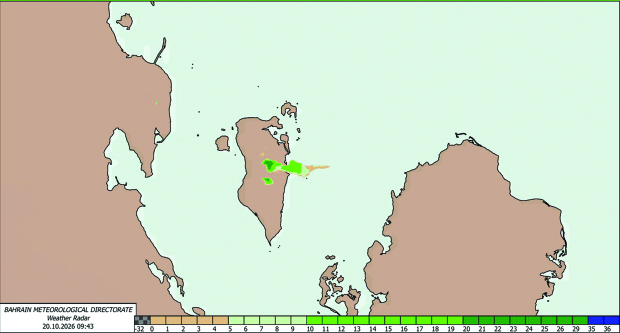
The unexpected formation of a thunderstorm cell led to rains yesterday in some parts of the kingdom
The directorate on Monday forecast cloudy conditions for yesterday, with temperatures ranging from 24C to 37C and northeasterly winds of five to 15 knots. No rain was forecast.
Yesterday morning, the forecast was updated to ‘rather hot during the day and humid at times’, with temperatures ranging from 25C to 38C and humidity reaching 80 per cent. A few hours later, an unexpected thunderstorm cell formed.
A thunderstorm cell, or storm cell, is the basic building block of a thunderstorm, consisting of a single convective cycle of rising air, known as an updraft, and sinking air, or a downdraft. A typical storm cell lasts between 30 and 60 minutes and develops through three stages.
During the first, or development stage, warm, moist air rises and forms cumulus clouds, with little or no rainfall.
In the second, or mature stage, the storm can reach heights of up to 60,000 feet, with both updrafts and downdrafts developing as precipitation intensifies. This can bring strong winds, heavy rain or hail.
During the final, or dissipating stage, the updraft weakens, rainfall eases and the cloud gradually breaks apart.
Thunderstorm cells are generally uncommon in Bahrain due to the country’s arid, desert climate.
Bahrain receives less than 100mm of rainfall annually on average, while for much of the year the atmosphere lacks the moisture needed to trigger convection. When such storms do occur, they tend to form during the winter months and the Sarayat season, which runs from late March to mid-May.
Meanwhile, the Meteorological Directorate has forecast no rain for the rest of the week, with similar weather conditions expected from today until Saturday.
Conditions are forecast to remain cloudy but dry, with maximum temperatures of 37C during the day, falling to around 25C at night.
Winds are expected to be northeasterly from today until Friday, shifting to northwesterly on Saturday, with speeds ranging from five to 15 knots each day.
nader@gdnmedia.bh
