

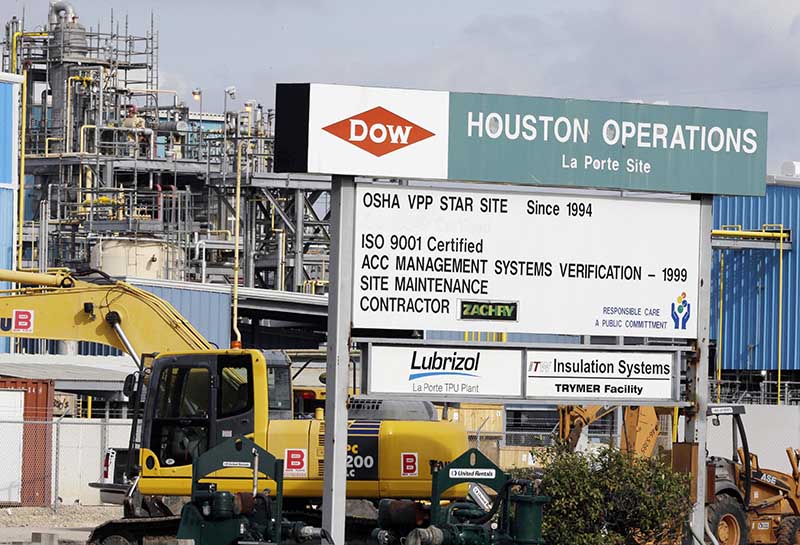
New York: Chemical giants DuPont and Dow Chemical agreed to merge in an all-stock deal valuing the combined company at $130 billion in a win for activist investors that could spark further consolidation in the farm chemicals industry.
The deal to combine two of the biggest and oldest US chemical producers is a prelude to an eventual split-up of the combined company into three discrete businesses, Dow and DuPont said yesterday.
But it is likely to face intense regulatory scrutiny, given an extensive overlap of their agriculture businesses.
The proposed split would create businesses focused on agriculture, materials and specialty products.
Excluding preferred shares, existing shareholders of Dow and DuPont will each own about 50 per cent of the combined company, to be called DowDuPont.
DuPont chief executive Ed Breen will be CEO of the new company, and Dow Chemical CEO Andrew Liveris will be executive chairman.
Dow Chemical shareholders will get one DowDuPont share for each Dow Chemical share held, while DuPont shareholders will get 1.282 shares in DowDuPont for each DuPont share they own.
The merger, one of the biggest of the year, will allow Dow and DuPont to rejig assets based on the diverging fortunes of their businesses that make agriculture chemicals and plastics.
The companies have been struggling to cope with falling demand for farm chemicals due to falling crop prices and a strong dollar, even as their plastics businesses have thrived thanks to low natural gas prices.
“This transaction is a game-changer for our industry and reflects the culmination of a vision we have had for more than a decade to bring together these two powerful innovation and material science leaders,” Liveris said.
The companies said the split would “occur as soon as feasible” and would likely happen 18-24 months after the deal closes, which is expected in the second half of 2016.
The combination will help the companies save about $3bn in costs in the first two years, with the possibility of saving another $1bn, Dow and DuPont said.
The biggest of the three new companies by revenue would be a material science company, which would cater to the packaging, transportation and infrastructure industries. The combined revenue for the materials business was about $51bn in 2014 on an adjusted basis.
The companies said a new specialty products company would focus on electronics. The combined adjusted revenue of that business was about $13bn in 2014. The third business, selling seed and crop protection chemicals, generated adjusted revenue of about $19bn.
The merger puts further pressure on rivals such as Germany’s BASF and Bayer to consolidate as falling crop prices curb sales.
It could also prompt a renewed flurry of takeover bids for European rivals, with Syngenta AG the most likely target.
Analysts have said a Dow-DuPont tie-up might push Monsanto to take another shot at Syngenta after the US company abandoned a $45bn offer for the Swiss company in August.
“The biggest impact will certainly be in the agriculture market, where the seeds and crop chemical industries are to undergo rapid consolidation,” SunTrust Robinson Humphrey analyst James Sheehan said.
Activist investor Nelson Peltz, who has long championed breaking up stodgy conglomerates, has been pressing DuPont to separate its agriculture, nutrition and biosciences units from its building and safety materials divisions.
&uuid=(email))