

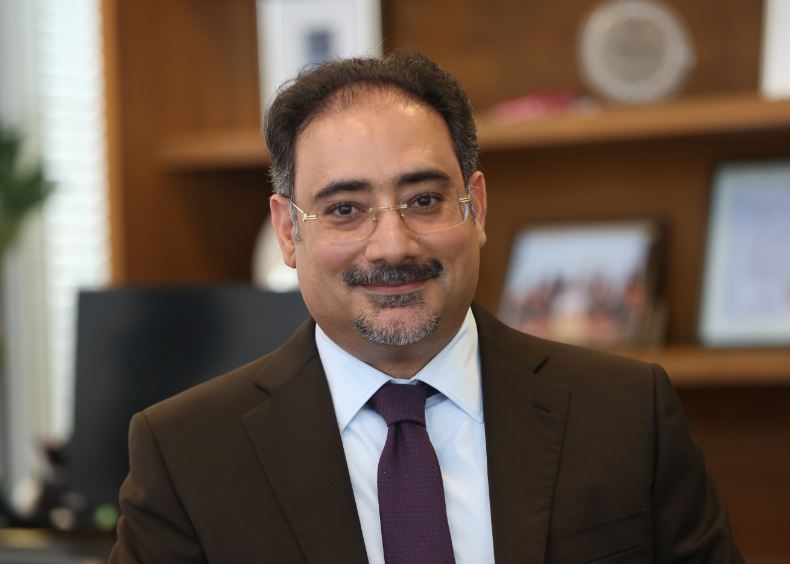
READERS may be excused for not having heard of Edamah, the real-estate arm of the kingdom’s sovereign wealth fund Mumtalakat, until recently when it started winning global recognition.
As soon as it was given a licence to go out and ‘deliver’ under an independent board and a charismatic chief executive, its impact on the community has been startling.
“We have become more prominent because we are doing things, it’s moving, we’re starting to engage, and 2020 is the year of delivery,” said CEO Amin Alarrayed who was there at the start.
He’d made the headlines in recent years as First Bahrain’s chief executive, spearheading opening of the popular Spanish-themed El Mercado Janabiya retail centre and its adjacent residential villa project, but the chance to join a new-look Edamah proved too tempting.
“The real driver for me to join Edamah was the ability to make a positive impact, taking into account the size of the portfolio it manages.
“I came in initially as a board member before they offered me the CEO’s position. The mandate for the board was to put in a new strategy, to ‘activate’ Edamah. In my opinion it was a sleeping giant.”
Its roots date back to the creation of Mumtalakat and a Royal Decree establishing its mandate in 2006.
The sovereign wealth fund was set up to align and implement execution of the government’s initiatives, to pursue value-enhancing opportunities, improve transparency and help achieve operational excellence for its state-owned, non-oil and gas related assets. The Arabic name ‘Mumtalakat’ (or assets) was chosen to reflect the importance of the new holding company’s mandate.
“From the start Edamah was run as a kind of department of Mumtalakat. The feeling was that the company would not move forward unless it was given its own board, own leadership, and that’s exactly what they did in 2018, when they reconstituted an independent board.
“And, whenever you have that kind of scenario, for someone like me, it’s very appealing. You get to put in strategy and you are mandated and empowered to make changes.
“I was with them for about a year on the board, when we were doing things primarily related to strategy. I was part of its investment development committee so I was looking at potential projects.
“We said that it didn’t make much sense for the government’s real estate arm to be involved in small or insignificant projects.
“We needed to identify five high-impact ones that would ‘move the needle’. These were projects that if done well, would make a positive and significant impact on the economy.
“There are seven members on the board who are predominantly industry specialists – people that really ‘value add’, are active, involved, multi-disciplined professionals.
“It’s not a ceremonial board, but a professional one and having that kind of composition was very appealing to me.
“By bringing in private sector industry specialists at board level and hiring me, a private sector guy, the powers that be really want to make sure Edamah is run on a professional basis, so it’s no longer seen as a bureaucratic organisation. This really is the shift.
“Typically we are a property, land-bank manager and developer. However, what makes us different is that we also aim to add value to civil society through real estate.
“But we will never be a cut-throat private sector developer. Edamah has a social conscience and needs to make a difference. A positive impact every time is what we seek.”
The proof is in the pudding. Edamah has relationships with around 100 civil societies offering community support services, with many occupying spaces in properties it owns. A Down’s syndrome organisation recently expanded to cope with a demand for help.
When offered the CEO position, as good governance dictates, he had to step down from the board.
“It put me in a position where I’m now part of the execution of plans. I believe that’s what they spotted in me, that this was a guy who executes, if I had to pick one word. I had the track record,” he said.
“It is fine to plan and strategise but it’s something else to execute. We needed all our planning to be translated into action. And, that really is what 2020 is all about. 2020 for Edamah is all about delivery.”
Engagement with the private sector is no insignificant matter either but a ‘key’ approach.
“The private sector is the biggest validation of a project, in my opinion,” he explained. “If someone is willing to put his or her hard-earned money into something then he or she is going to make sure it works. That is not always the case when you are centrally planning everything.
“The other partners invited to work with Edamah are banks. For the first time we have invited banks to participate in the funding of our projects, so we are no longer limited by our capital.
“We issue tenders and invite the banks to come on board. We say, for example, we are building a car park, would you like to help fund it? And we invite them to participate.
“It also provides validation of our projects because banks, before they lend, always carry out their own scrutiny.
“They make their money by charging us interest, while investors take a share of the profits. If things make sense, why not?
“I go back to our three objectives; make it financially viable, with both a positive economic and positive social impact.”
And, there will be plenty of chances to fulfil those pledges. Edamah has more than 200 plots of land, he revealed, a sizeable land bank with a large chunk inactive, possibly as much as 80 per cent.
“Our job really is to look at the land bank and to identify plots that we should be focusing on,” said Mr Alarrayed.
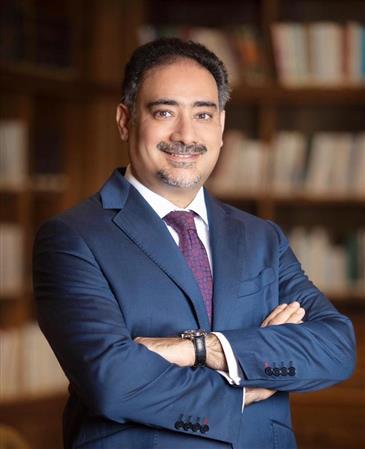
Mr Alarrayed
“We identified five key projects but above and beyond that, let’s take a look at the land bank and ask what we need to focus on? Are there industrial plots we can start to develop, or are there more educational ones?
“It’s a rolling portfolio of land and properties scattered all over the island. It’s a hotchpotch. We have industrial land, we have land in residential areas, we have land in commercial areas, we have islands. Remember, it’s the government land bank.
“Our goal is to sort through all these, characterise them, identify the ones that need to be developed, and work on them. That’s my mandate.”
Quite a challenge for the former Bahrain School pupil who was born in the maternity unit in Muharraq and is part of a family with roots in Manama for generations.
He went on to study economics in Southern California at the US University of Redlands, and after graduating in 1996, started work at the Central Bank of Bahrain as an economic researcher. He joined BBK, working his way up to retail head of the bank’s branches, as well as head of placement at Reef Real Estate Finance Company before First Bahrain came calling and the subsequent move to Edamah.
Married to Rusul Al Hashamei, an executive secretary at Asool Asset Management, the couple live in Saar with their two children, Ahmed, 16, and Yasmeen, 14.
He heads a team of 65 employees working in three main areas. The development team is responsible for planning and execution of projects. Property management runs leasing, engagement with tenants and collection activities. And, asset management provides support services, HR, finance, administration and is considered the ‘spine’ of the organisation.
The team is winning accolades already. Construction Week named Edamah one of the top 100 GCC Real Estate Developers in its 2019 list of the region’s 'most influential and successful property firms'.
“We’re extremely proud. International independent recognition is validation of our strategy, indicating that we are moving in the right direction,” said Mr Mr Alarrayed.
“Although I think the reaction was the same as many, where did this company come from?”
Not anymore.
Read more:
Educational park to open in Isa Town
Edamah to deliver key projects this year
New industrial park in Sitra to support SMEs
Aiming to ‘bring Muharraq back to the sea’
Providing a smart fix for Bahrain’s parking woes
&uuid=(email))