

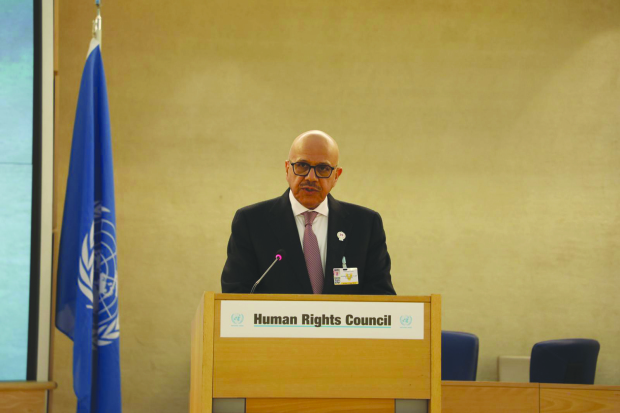
Bahrain has urged the United Nations to recognise the Middle Eastern nations’ right to peace.
The UN Human Rights Council must prioritise lasting peace in the region, Foreign Minister Dr Abdullatif Al Zayani said yesterday.
In his remarks to the 58th session of the council in Geneva, he called on member states to support efforts to promote stability, dignity and coexistence in the Middle East.
The minister underscored Bahrain’s commitment to human rights, tolerance and peaceful coexistence.
He stressed that Bahrain’s approach to peace extends beyond political discourse to a comprehensive strategy that fosters stability and security, respects human rights and resolves conflicts through dialogue rather than war.
The Foreign Minister noted that global challenges require a renewed commitment to justice, equality and peace.
He added that at the 33rd Arab Summit, chaired by His Majesty King Hamad, Arab leaders underscored the critical role of human rights, development and peace in shaping a prosperous future.
The Bahrain Declaration outlined a comprehensive vision for regional stability and highlighted the importance of Arab co-operation in addressing human rights challenges.
Dr Al Zayani said that the summit called for an international conference to resolve the Israeli-Palestinian conflict that has been ongoing for more than 70 years, and proposed human rights initiatives, including healthcare and education for those affected by conflicts and regional disputes.
The minister said that Bahrain has formed a specialised national committee to co-ordinate and oversee the implementation of the Arab Summit initiatives, ensuring their effective and sustainable execution.
He emphasised that discussions on human rights must be grounded in the principles of solidarity, particularly in relation to peace and stability.
He highlighted that the absence of security and ongoing armed conflicts pose serious risks to civilian lives and threaten fundamental human dignity, reaffirming that defending the right to life is central to the Human Rights Council’s mandate.
Furthermore, Dr Al Zayani reiterated Bahrain’s support for global security and peace initiatives while opposing violence, extremism and terrorism.
He said that the kingdom underscores that achieving a just and comprehensive peace in the Middle East requires protecting Palestinian people’s rights, preventing their displacement, and establishing a fully sovereign Palestinian state coexisting peacefully with Israel.
Bahrain, under the leadership of His Majesty King Hamad and the continued follow-up of His Royal Highness Prince Salman bin Hamad Al Khalifa, Crown Prince and Prime Minister, has implemented key initiatives to promote and safeguard human rights and freedoms, the minister added.
He emphasised that the kingdom’s achievements in this area reflect its steadfast commitment to upholding and protecting these rights.
Dr Al Zayani outlined the main royal initiatives, including the pardon that led to the release of more than 3,700 inmates last year, the successful implementation of alternative sentencing since 2017 and the introduction of open prisons.
He reiterated Bahrain’s commitment to advancing the rights of women and children.
The minister emphasised Bahrain’s commitment to fulfilling international obligations, noting its review of seven international conventions and two optional protocols related to the rights of children and persons with disabilities.
Dr Al Zayani also highlighted Bahrain’s success in addressing 128 out of 172 recommendations from the Universal Periodic Review (UPR) over the past two years, implementing national human rights action plan projects and preparing for the next phase.
Top stories for today:
Cold and windy weather expected until weekend
Regional developments discussed
Region’s right to peace ‘is crucial’
&uuid=(email))