

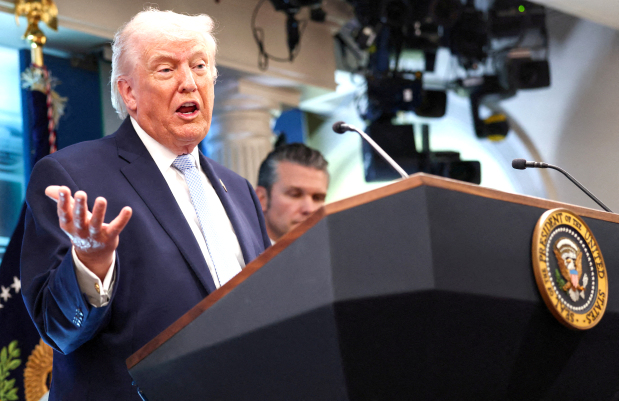
US President Donald Trump, upset at Nato allies’ failure to help secure the Strait of Hormuz and angry that his plans to acquire Greenland have not advanced, has discussed with advisers the option of removing some US troops from Europe, a senior White House official said yesterday.
No decision has been made, and the White House has not directed the Pentagon to draw up concrete plans for a troop reduction on the continent, said the official, who requested anonymity to discuss internal deliberations.
But the discussions alone underscore how sharply relations between Washington and its European Nato allies have deteriorated in recent months.
They also suggest that a visit to the White House on Wednesday by Nato Secretary-General Mark Rutte failed to significantly improve transatlantic relations, which are arguably at their lowest point since Nato’s 1949 founding.
The White House has publicly said that Trump has considered withdrawing from the alliance altogether.
Removing troops from Europe would allow Trump to dramatically lessen Washington’s security commitments on the continent, without formally withdrawing, a move that would test constitutional law.
The US currently has more than 80,000 troops in Europe and has played a central role in Europe’s security architecture since the Second World War.
More than 30,000 of those troops are located in Germany, with sizeable numbers also stationed in Italy, the United Kingdom and Spain.
The official did not say which countries could be affected or how many troops might ultimately be withdrawn if Trump decides to move forward with the idea.
Asked for comment, a Nato spokesperson referred Reuters to Rutte’s interview with CNN on Wednesday.
In that interview, Rutte said that he understood Trump’s frustrations with the alliance, but that the ‘large majority of European nations’ had been helpful to Washington’s war effort in Iran.
Following Rutte’s meeting with Trump, the secretary-general told European governments that Trump wants concrete commitments to help secure the Strait of Hormuz within days.
While Trump has long had a tumultuous relationship with Nato – for years accusing European capitals of skimping on defence spending – the last three months have been particularly rocky.
In January, Trump provoked a transatlantic crisis when he renewed longstanding threats to annex Greenland, an overseas territory of Denmark.
Since the war with Iran broke out on February 28, he has expressed deep frustration that Nato allies have not offered to help reopen the Strait of Hormuz, a vital route for global energy supplies that has remained largely closed despite a fragile ceasefire announced this week.
&uuid=(email))