

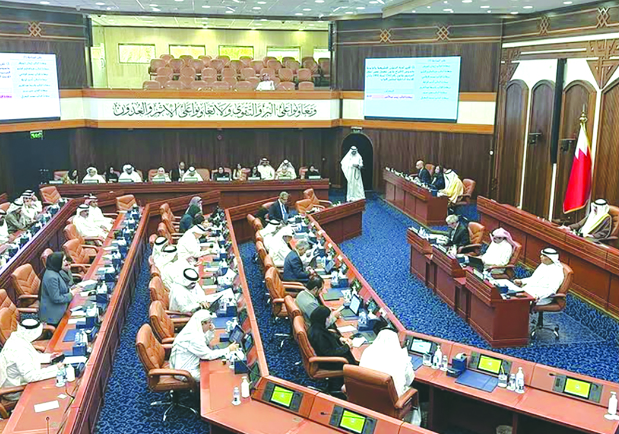
MPs will debate key amendments to the kingdom’s execution law, aimed at curbing debt evasion and preserving the state’s power to deport expatriates who threaten public order.
Two draft laws amending Article 40 of the Law No 22 of 2021 on Execution in Civil and Commercial Matters are set for debate during Parliament’s session on Tuesday.
The proposals were merged into a single framework after months of review and returned to the committee earlier this year for further study before coming back in amended form.
At the heart of the debate is how far courts should go in restricting travel for debtors – particularly expatriates – without infringing on constitutional freedoms or weakening the government’s power to deport foreigners under criminal or administrative orders.
Under the current law, an execution judge may ban a debtor from travel for up to three months, renewable three times, if there is a risk of flight and no visible assets to settle debts. However, the law clearly states that such a travel ban does not prevent the enforcement of a final deportation order or the administrative power to terminate an expatriate’s residency.
One proposal sought to give judges broader powers to keep expatriate debtors in the country if they failed to provide financial guarantees. Another suggested forming a judicial committee to decide whether a deportation order or a travel ban should take priority.
The Cabinet strongly objected to both approaches, warning they could violate constitutional rights, undermine equality before the law, and intrude on the executive branch’s sovereign authority to deport foreigners in the interest of national security and public order.
After consultations with the Justice, Islamic Affairs and Endowments Ministry and the Bahrain Bar Society, the committee opted for a middle path.
Instead of differentiating between citizens and expatriates, the committee recommended a full redrafting of Article 40. The amended text removes the cap on the number of renewals for travel bans, allowing judges to extend the ban for repeated three-month periods without fees as long as the reasons for the ban persist.
At the same time, the revised wording explicitly preserves the state’s power to enforce deportation rulings and residency termination orders, avoiding any conflict between court-imposed travel bans and executive authority.
Committee chairman MP Mahmood Mirza Fardan said the changes were designed to close loopholes frequently exploited by absconding debtors.
“We have seen many cases where debtors, especially expatriates, take advantage of procedural limits to leave the country before creditors can recover their dues,” he said.
“The committee wanted to give execution judges practical tools to prevent abuse, while fully respecting constitutional principles and the government’s sovereign powers.”
In addition to the travel ban amendments, the committee also recommended introducing a new provision to Article 58 of the same law. This would require execution judges to refer debtors for criminal investigation if they deliberately hide assets, provide false information, or refuse to disclose financial details after being formally ordered to do so.
Mr Fardan said this step was necessary to strengthen accountability in execution cases.
“Refusing to disclose assets or misleading the court is not a minor procedural issue, it is a deliberate obstruction of justice. This amendment ensures there are real consequences,” he added.
If approved, the amendments will come into force six months after publication in the Official Gazette, giving authorities and courts time to adjust procedures.
“For expatriates living and working in Bahrain, the debate is particularly significant,” said Mr Fardan.
“The final wording maintains the government’s right to deport individuals when required for public interest, while giving creditors and courts stronger safeguards against debtors attempting to flee the country to escape legal obligations.”
&uuid=(email))