

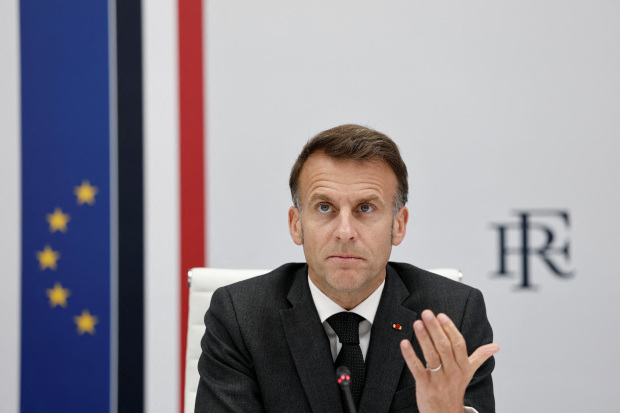
French President Emmanuel Macron urged high school pupils yesterday to switch off their phones and read, pushing for one ‘no screens day’ per month for all, and a blanket social media ban for those under 15 years of age.
Following Australia’s groundbreaking social media ban for children launched last year, a growing number of European nations are weighing their own restrictions as concerns mount over social media’s impact on the health and safety of minors.
“We left you in this jungle and it robbed you of your attention,” Macron told high school kids, speaking of the lack of rules on social media. “We need to slow down and help you become adults, and above all citizens.”
“That’s why what we want to do is say that before 15 years old, no more social media. And we’d like, one day a month, to have an offline day ... to show it’s possible,” he said, adding that this day could be used to read aloud, do theatre or other activities.
In France, a draft bill is going through parliament with the aim to establish a ban for those under 15.
But while the lower house has voted for a blanket ban, senators want to block access only for platforms that are considered harmful for children. This means Macron’s aim to have the new legislation in place for the start of the new academic year in September may not be met.
So far, at least a dozen European countries, including non-EU nations Britain and Norway, have enacted or are considering legislation setting minimum age limits – typically between 13 and 16 years – for social media usage.
And the EU is readying an age verification app.
Cyprus was the latest to announce plans to establish a ban, with President Nikos Christodoulides saying yesterday that his country would set the age of 15 as the minimum for creating and using an account on social media platforms.
In Villers-Cotterets, in northern France, where Macron laid out some of his plans, high school students had mixed feelings about a ban. “I think it’s rather up to parents to check up on their children,” said 12-year-old Erdem Duran. Fabien Andronic, aged 15, also disagreed with a ban. “I like social networks, we learn a lot there,” he said.
But Manel Zerouali, also aged 15, agreed with a ban for those under 15, so they can be protected. “On social network there is cyberbullying,” she stressed.
One thing all agreed on was that most youngsters would find a way around a ban. Australia has seen a huge spike in downloads of virtual private networks (VPNs) since it introduced its social media ban, as users seek to bypass the measure to access restricted platforms.
Meanwhile, in Britain, Prime Minister Keir Starmer told social media companies yesterday to take responsibility for children’s safety on their platforms and meet parents’ demands for credible protection rather than ‘tweaks around the edges’.
He said he wanted to hear what actions the platforms were going to take because ‘right now, social media is putting our children at risk’ at the start of a meeting with executives from Meta, Snap, Google, TikTok and X.
&uuid=(email))