

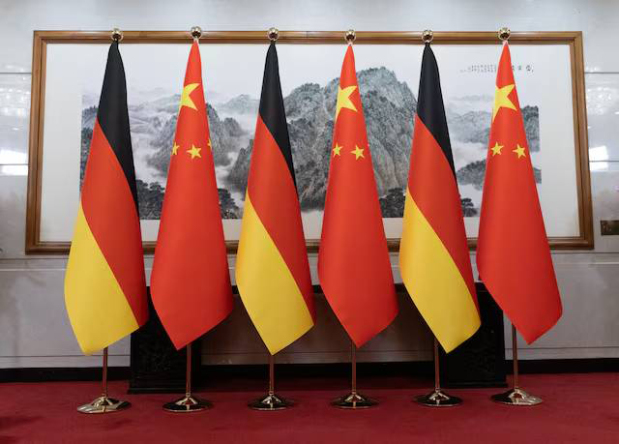
GERMANY’S economy minister said in Beijing yesterday that a modern economic relationship requires both co-operation and competition, as Europe’s biggest economy tries to manage tensions with its largest trading partner.
Germany, the world’s third-largest economy behind the United States and China, has been particularly exposed to rising protectionism and global trade shifts, squeezed by rising competition from Beijing as well as import tariffs from Washington.
“Competition makes us stronger, co-operation creates stability and innovation creates shared progress,” Katherina Reiche said on her first trip to China.
With a trade volume of around €250 billion ($291.2bn), China was again Germany’s largest trading partner in goods in 2025 and around 5,000 German companies are currently active in China.
Reiche stressed that Germany is seeking dialogue with China because fair competitive conditions are required.
“Our companies do not shy away from competition,” Reiche said. “But competition must be shaped and organised in such a way that it is of mutual benefit.”
In a meeting with Reiche yesterday, China’s Commerce Minister Wang Wentao said China was willing to strengthen dialogue and consultation with Germany to “expand the list of co-operation and shorten the list of issues”, according to a statement released by his ministry.
“Protectionist” trade curbs recently introduced by the EU have seriously disrupted co-operation between Chinese and European businesses, Wang said, adding that China and Germany should jointly support free trade and multilateralism.
German exports to China fell by around 10% in 2025 to about €80bn, while imports from China rose to around €170bn, resulting in a trade deficit.
The minister is travelling with a delegation that includes top executives from BASF, Thyssenkrupp and Siemens Energy, among others.
Thyssenkrupp CEO Miguel Lopez said fair trade remained key, but it was also crucial that Chinese companies were being welcomed in Europe, similar to German firms when they went to China decades ago.
“We have received a great deal of support from the Chinese government and we have now reached a point where, in my opinion, this should work just as well in the opposite direction,” he told broadcaster ZDF on Tuesday.
“We welcome investment by Chinese companies in Germany,” Reiche said on Wednesday. “Many are active and here too investments are increasing.”
The visit comes three months after German Chancellor Friedrich Merz’s trip to China, a visit that sought to reset ties based on some key dependencies, most notably in rare earths. Reiche said she spoke with Chinese counterparts about having “reliable access” to critical minerals for German companies, without giving further details.
Reiche praised industrial technology and innovation in China, adding that Germany and China were linked by one of the most important economic relationships in the world.
“Our shared interest is to keep these relations stable,” Reiche said. “Stable, respectful, reliable, fair and focused on balance.”
&uuid=(email))