

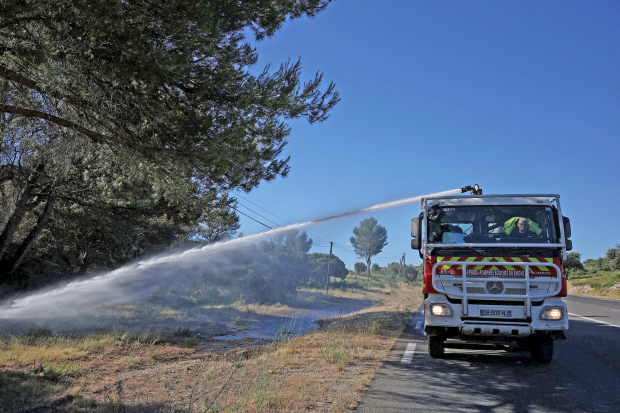
TWO thousand firemen were battling several wildfires fanned by strong winds along France’s Mediterranean coast yesterday, as the region grappled with parched conditions following Europe’s recent heatwave.
Television images showed warehouses and a yacht ablaze in a marina in the town of Canet-en-Roussillon, near the Spanish border, as a thick cloud of dark smoke blew over the beach.
Local authorities said 1,500 people had been evacuated from the town’s campsites and the airport in nearby Perpignan was closed.
Earlier in the day, firemen brought two fires under control on the outskirts of Marseille, France’s second-biggest city, but were struggling to contain another bigger blaze in the Aude administrative department.
Prime Minister Sebastien Lecornu, whose minority government faces a no-confidence vote in parliament over its handling of the heatwave, held a crisis meeting in Marseille. France’s weather office has warned that another spell of extreme heat could hit next week.
Lecornu said that 8,700 hectares had burned in France so far this season, including 1,200 on Wednesday alone.
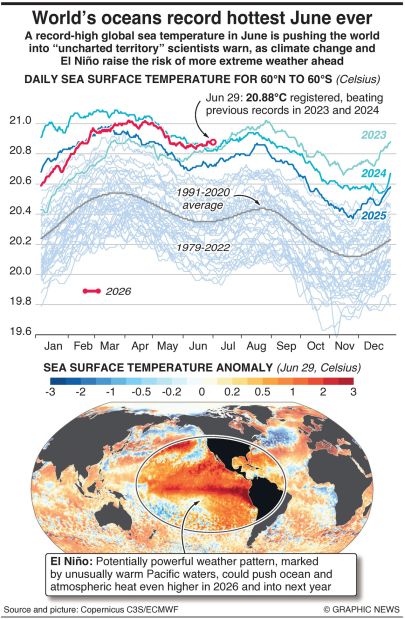
The World Meteorological Organisation last week warned that the record temperatures that baked Western Europe for over a week in late June would worsen the risk of wildfires, given the outlook for sustained high temperatures, very low humidity and dry vegetation.
In Canet-en-Roussillon, four helicopters were deployed to help tackle the blaze and three Canadair firefighting planes were on standby.
“Our main concern is the industrial zone, where many industrial buildings are located. Some contain potentially polluting substances and flammable materials,” Pierre Regnault de la Mothe, the top official in the Pyrenees-Orientales department, told reporters.
To the east, the fire in the Aude scorched some 900 hectares as winds reaching 70 kilometres per hour complicated the efforts of nearly 700 firemen.
Health authorities estimate the previous heatwave may have caused at least 1,000 excess deaths in the country during record-breaking temperatures.
Meanwhile, with Spain already sweltering under successive heatwaves that caused more than 1,000 excess deaths in June, Barcelona has begun to hand out heat-monitoring bracelets to its outdoor workers to act as an early warning system for health risks.
The city has rolled out around 1,400 bracelets for staff working outdoors, including street cleaners, lighting crews, park workers and waste management employees.
The bracelet measures the workers’ body temperature and emits a sound and vibration if it senses that the wearer is at risk. A number of street workers have died in recent years across Spain as temperatures spiked, prompting changes in working patterns and conditions.
&uuid=(email))