

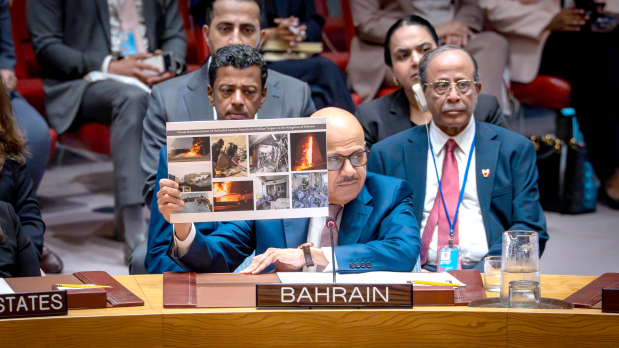
FOREIGN Minister Dr Abdullatif Al Zayani said that the recent Iranian attacks targeting populated civilian areas in the kingdom are not isolated incidents, but part of a sustained campaign of repeated attacks that began on February 28 and have continued to the present day, including after the signing of the US-Iran agreement.
Addressing the emergency meeting of the United Nations Security Council, convened at the request of Bahrain, the minister called on the council to reaffirm its condemnation of Iran’s repeated attacks, require the Iranian regime to cease them immediately, ensure full compliance with Security Council Resolution 2817 (2026) and its obligations under international law, and establish an effective mechanism for implementation and accountability.
Dr Al Zayani stated that Bahrain had requested the emergency session in recognition of the Security Council’s primary responsibility for maintaining international peace and security, and in the expectation that the council, which had already condemned Iran’s attacks against GCC member states and Jordan in Resolution 2817 (2026), would not remain a bystander in the face of such a blatant challenge to its authority.
He noted that Bahrain, one of the world’s most densely populated countries, has extensive overlap between industrial facilities, critical infrastructure and residential communities. Since the beginning of the conflict, the kingdom has been subjected to 808 attacks, including 203 ballistic missiles and 605 drones.
He said the attacks deliberately targeted civilian infrastructure, critical facilities, and residential areas, killing three civilians and injuring 465 others, including women and children. He stressed that, without the precautionary measures taken by the relevant authorities, the human toll could have been significantly higher. Beyond the casualties and physical damage, he said, the attacks terrorised civilians, spread fear among the population, and disrupted daily life, which is a conduct prohibited under international humanitarian law.
Rejecting claims that the attacks were directed at military targets, the minister questioned the justification for striking a desalination plant, residential neighbourhoods, civilian facilities, and other essential infrastructure.
He also informed the council that Bahrain had circulated visual documentation showing damage to vital industrial facilities, residential buildings, and civilian and educational facilities in the Diplomatic Area. While representing only a portion of the overall damage, the material clearly demonstrates the deliberate targeting of civilians rather than military objectives, as Iran claims.
Dr Al Zayani highlighted the April 5 drone attack on operational units at the Gulf Petrochemical Industries Company in Sitra, which struck an ammonia storage tank located within a densely populated residential area. He said that, had authorities not acted in advance to empty the tank, the release of toxic gas could have caused a major humanitarian disaster.
He further warned that Iran’s continuing attacks, carried out directly and through its proxies, threaten not only Bahrain but the security of the wider region. He referred to attacks near Kuwait International Airport, which posed a serious risk to civil aviation and air navigation, and to the drone attack on the Barakah Nuclear Power Plant in the UAE, which caused a fire in an external electrical generator and brought the region close to a nuclear safety disaster.
“From a chemical facility, to a civilian airport, to a nuclear power plant,” he said, “the pattern is unmistakable: these are not military targets, as Iran claims, but part of a systematic campaign against the critical infrastructure upon which civilian life in our countries depends”.
He noted that Iran continued its attacks despite committing, under the agreement, to a permanent cessation of military operations, breaching that commitment within days.
He reiterated Bahrain’s call for the immediate and complete cessation of the attacks, urging the council to reaffirm its condemnation, compel Iran to comply fully with Resolution 2817 (2026) and international law, and establish an effective implementation and monitoring mechanism.
&uuid=(email))