

Delegations from almost 20 countries, including Bahrain, are currently in the country affectionally known as the Middle Kingdom to experience technology that could change the future of transportation. The GDN’s Bahraini assistant news editor Nader Adnan reports from Guiyang, China.
JOURNALISTS from across the globe are in China as part of an international media seminar by the International Department of the Central Committee of the Communist Party of China (IDCPC), which gave invitees a tour of several districts, including Guiyang, which is known for its green technology and industrial prowess.
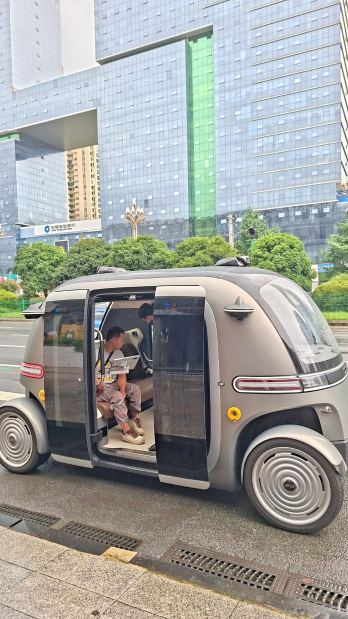
Delegates boarded the revolutionary RoboBus
Among its most notable achievements is a self-driving vehicle, known as ‘Potato Bus’ by locals due to its ‘ap-peel-ing’ shape.
Passengers were given a 20-minute tour in the vehicle on the streets of Guiyang, and all the passengers were amazed by the experience, that could soon be rolled out to streets across the nation.
Speaking to the delegates following the tour, Guizhou Provincial Development and Reform Commission representative Feng Jianen explained that its introduction comes as part of a push to introduce more green technology to a city that is proud of its growing green credentials.
“It is my great honour to have the opportunity to discuss and exchange ideas from people around the world,” said Ms Jianen. “In light of provincial conditions, Guizhou has set green development as a priority.

Ms Feng, second from left, during the meeting with journalists
“We are focusing on intelligent and integrated solutions in green technology, such as the autonomous vehicle.
“The city of Guiyang and the Guizhou Province are proud to have developed intelligent driving methods, that in the future could not only change the face of transportation in the city, but also have use in unique scenarios, such as mountain agriculture and underground mining.”
The Potato Bus (officially known as the RoboBus or Qiyu Loop) is an autonomous driverless minibus operating in the capital of the Guizhou Province, developed by the smart mobility tech company PIX Moving.
The vehicle has ‘gone viral’ on social media globally due its whimsical appearance and interior. Local residents nicknamed it the ‘Potato Bus’ because it features a completely symmetrical rounded body.
It has no front or back and can drive in both directions with ease with no traditional driving mechanisms – no steering wheels, no pedals and no rearview mirror.
Instead, the vehicle relies on ultrasonic radars, sensors and high-definition cameras to read traffic lights, navigate city streets, dodge any unexpected obstacles on the road and safely give way to pedestrians if needed.
It is purely electric with zero emissions and can carry up to six passengers at a time.
The urban loop spans 8km and takes roughly 20 minutes to complete a full circuit, connecting major shopping areas, business hubs, urban parks and residential communities.
Additionally, a full loop only costs about 20 Chinese Yuan (around BD1) per passenger.
Speaking to the GDN, one of the delegate members expressed how impressed they were with the vehicle, vouching for its comfort, reliability and safety.
“My experience on the RoboBus was nothing short of impressive,” said Bahamian chief reporter of The Tribune, Leandra Rolle. “I had often heard about self-driving vehicles and seen them on television and social media but actually riding in one was a very unique experience.
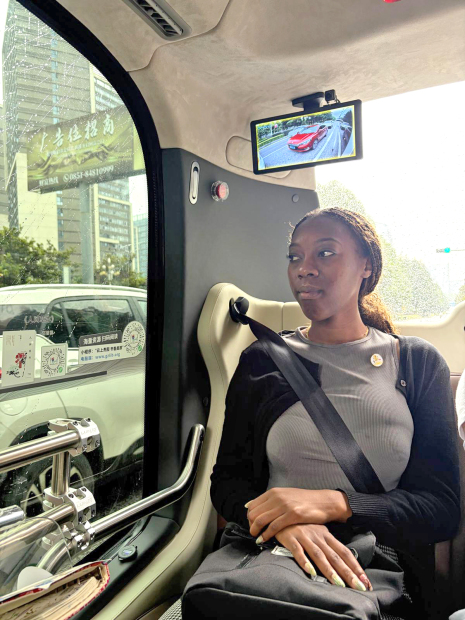
News ace Ms Rolle
“Although the ride was relatively short, it has left a lasting impression. I never had any major concerns about my safety. Instead, what stood out most was my curiosity and amazement at how rapidly technology is growing.
“There is no doubt that as technology evolves, self-driving vehicles will become increasingly common in many parts of the world.”
In 2025, RoboBus began operating a driverless shuttle route in Huaxi University Town, connecting campuses with surrounding residential and commercial areas. The service is open to the public and has been running long enough to accumulate real-world operational data.
The vehicle interiors may be used more flexibly, allowing for multiple roles beyond transport, such as cafes and the concept of moving or open office spaces.
In recent years, countries such as the UAE has become a leader in autonomous mobility, with fully driverless taxis actively running in Dubai and Abu Dhabi. In Dubai, especially Jumeirah and Umm Suqeim, passengers can book rides through Uber and the city aims for 25 per cent of all transportations to be autonomous by 2030.
Abu Dhabi boasts more than 120 such vehicles operating commercially in Yas Island and Reem Island.
Last month, in Bahrain, Transportation and Telecommunications Minister Dr Shaikh Abdulla bin Ahmed Al Khalifa said during a conference that the kingdom was preparing to open its roads to self-driving vehicles for the first time, with plans underway to introduce groundbreaking legislation that would allow autonomous cars to be tested and operated here.
He spoke during the Bahrain Smart Cities Summit 2026 where he revealed the kingdom was preparing an entirely new regulatory framework designed to attract global investment in advanced mobility solutions.
“Bahrain is moving towards introducing new legislation that will, for the first time, allow self-driving cars and autonomous vehicles to operate and be tested in the kingdom,” said Dr Shaikh Abdulla.
The minister revealed that pilot projects involving autonomous vehicles were already being worked on behind the scenes as authorities prepare the legal framework needed to encourage private sector investment in the emerging industry.
Dr Shaikh Abdulla highlighted Bahrain’s history as a technology testing ground, recalling how German automotive giant BMW once chose Bahrain to test the world’s first GPS navigation system installed inside a vehicle. He said the kingdom was not simply adapting to the future of transport – it wanted to help build it.
“And soon, that future may include driverless cars navigating Bahraini roads legally for the very first time,” the minister added.
And, the experience in China may offer vital real-world data and passenger feedback. Forget the potato bus, we might get the shawama express.
nader@gdnmedia.bh
&uuid=(email))