

Interpol yesterday said that more than 142,000 victims were identified during the global anti-fraud operation.
During Operation First Light 2026, a total of 152,808 cases were analysed, 31,014 bank accounts blocked, 23,715 cases solved, 15,606 suspects identified and 99 notices and diffusions issued.
The full spectrum of the financial fraud included running scam centres for money laundering activities in different countries.
Authorities in Singapore and Oman utilised Global Rapid Intervention of Payments (I-GRIP) to block a $6.6 million illicit transfer linked to a business email compromise scam.
“In this case, a Singapore-based commodity trading firm was targeted by criminals impersonating a supplier,” stated Interpol.
In Eswatini, police arrested 82 people and dismantled a criminal network running illegal online gambling, money laundering and elaborate impersonation scams.
Authorities seized 240 electronic devices, foreign currency and a realistic replica of a Brazilian police station, complete with fake uniforms, signage and equipment.
Posing as Brazil’s Federal Police via video call, the scammers deceived their targets into believing they were victims of a crime, tricking them into transferring funds for ‘safekeeping’, which were then stolen,” it added.
In Thailand, police made two arrests and uncovered a money laundering scheme that funnelled illicit funds from romance scams into various cryptocurrencies, utilising cross-chain token swaps to obscure the financial trail. A cross-chain swap allows one to move crypto assets directly between different blockchain networks.
Investigations showed that the digital wallet of one of the suspects, aged 20, had processed more than $122.5m in just 10 months, Interpol added.
Police in Macao, China carried out anti-fraud community outreach as part of Operation First Light 2026.
“Police discovered that one of the public participants was actively being manipulated by a criminal syndicate,” it said.
“Impersonating public officials, the perpetrators had convinced the victim to transfer money under the guise of a fraud investigation.
“Thanks to the public campaign, police were able to intervene before the victim sent nearly $372,000 to the fraudsters.”
Authorities in Palau deported 22 individuals for their role in two connected scam centres operating from hotels.
The suspects used cryptocurrency and illegal gambling websites to target victims in foreign countries, operating a range of online fraud schemes.
“Social engineering scams continue to pose a significant threat to our society,” said Interpol’s Financial Crime and Anti-Corruption Centre director Tomonobu Kaya.
“Criminal syndicates exploit human psychology to manipulate their targets, and no nation can stay safe unless all countries are equipped and committed to jointly fighting back.
“Interpol is dedicated to supporting member countries in building a comprehensive, co-ordinated strategy to tackle cyber-enabled financial crimes, organised criminal networks and the money laundering that fuels them.”
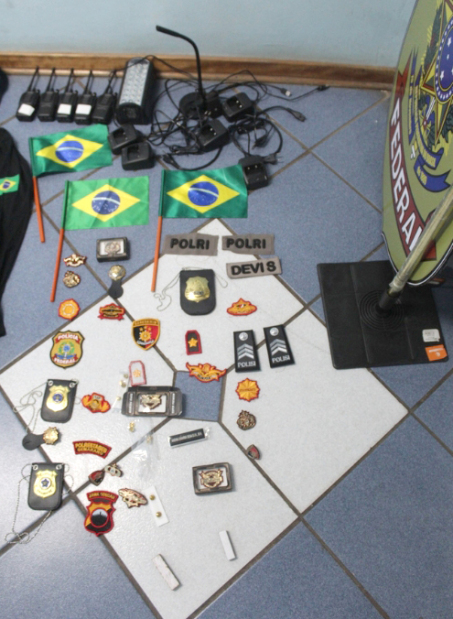
An illegal online gambling and money laundering network busted in Eswatini as part of the operation
The Interior Ministry joined Interpol in 1972 and has a dedicated section that contacts the Lyon-based agency to issue different notices to arrest suspects who fled Bahrain or locate a missing person.
Interpol has no police force of its own and relies on information shared by its 196 member nations.
Interpol assistance was requested by Bahrain in a high-profile case following a Rolex raid at a store in City Centre Bahrain in 2013.
Interpol alerts were put out against six eastern European men who stole watches worth $1.4m while disguised as women.
Another case where assistance was requested was in connection with a Chinese national who was allegedly linked to a string of at least 14 robberies or attempted robberies since 2012, including in Bahrain, Austria, Belgium, France, Germany, Malaysia, Monaco, Switzerland and the UK.
The individual allegedly stole a diamond ring worth $1.5m during an exhibition in Manama in 2013.
sandy@gdnmedia.bh
&uuid=(email))