

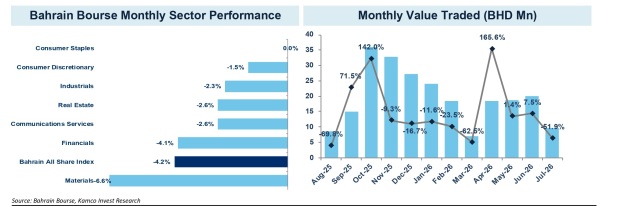
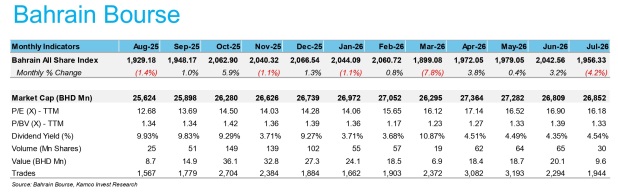
The Bahrain Bourse All Share Index snapped a three-month winning streak in July 2026, dropping 4.2 per cent to close the month at 1,956.33 points, driven down by broad weakness across key sectors.
According to a report by Kamco Invest, the pullback was widespread, with six out of seven sector indices trading lower.
Heavyweight sectors bore the brunt of the downturn, led by materials, which registered the sharpest drop of 6.6pc to close at 4,203.68 points. The financial sector slipped 4.1pc, while real estate declined 2.6pc. The consumer staples sector was the sole calm spot, closing flat at 2,375.6 points.
Despite overall market headwinds, select equities recorded gains, according to Bloomberg data.
Sector-Wise graph
Gulf Hotel Group topped the monthly gainers list with a 2.8pc increase in its share price. It was followed by Kuwait Finance House–Bahrain (KFH), which rose 2pc, buoyed by strong financial performance and payout announcements.
KFH reported a 6.1pc year-on-year rise in net profit for H1-2026, reaching KD363.1 million (BD441.4m) compared to KD342.1m (BD416m) in H1-2025, while also declaring a cash interim dividend of 10pc of nominal share value (10 Kuwaiti fils or approximately 12.21 Bahraini fils per share).
Sector-Wise graph
On the decliners’ side, GFH Financial Group led the losses with an 8.2pc share price decline during the month. Al Salam Bank–Bahrain and Alba followed close behind, posting monthly losses of 6.8pc and 6.6pc, respectively.
Trading activity on the exchange experienced a steep deceleration in July 2026 compared to the previous month. The total volume of shares traded fell by 52.8pc to 30.5m shares, down from 64.5m shares in June.
Similarly, the total value traded dropped by 51.9pc to BD9.6m, compared to BD20.1m recorded in the prior month.
In terms of trading activity by counter, Al Salam Bank dominated the volume chart with 8.9m shares traded, followed by GFH with 8.3m shares and Gulf Hotel Group with 3.7m shares. On the value chart, GFH led liquidity with BD4.6m worth of shares exchanged, while KFH and Al Salam Bank recorded BD2.1m and BD1.9m in value traded, respectively.
In a positive offset to equities, Bahrain’s property market recorded growth in sales for the first time since January 2026.
Figures from the Survey and Land Registration Bureau (SLRB) revealed that total real estate transactions reached BD134m in July 2026, with 988 completed sales compared to 857 in June.
The July uptick follows a sluggish first quarter in 2026, where regional geopolitical uncertainty caused foreign buyers to retreat. Overseas investors completed 202 transactions worth BD18.6m in Q1-2026 – representing a 29pc drop in volume and a 20pc decline in value year-on-year – which squeezed the foreign buyer market share from roughly 13pc in Q1-2025 to just over 9pc in Q1-2026.
Zooming out, GCC equity markets fell for a third consecutive month in July, dragged down by broad losses across the region, with Saudi Arabia leading the downturn as weakness in key sectors outweighed gains in heavyweights.
The MSCI GCC index dropped 0.7pc during the month, reflecting low- to mid-single-digit declines across most regional exchanges. Kuwait and Abu Dhabi managed to buck the trend, posting marginal gains.
Saudi Arabia’s benchmark TASI index fell nearly 2pc, marking its fourth straight monthly loss. The decline was broad-based across most sectors, though losses were partially offset by gains in major energy and telecom stocks.
The July drop eroded year-to-date performance across several regional bourses. Oman’s year-to-date gain narrowed to 24pc, while Saudi Arabia’s year-to-date rise shrank to 0.9pc. Meanwhile, benchmark indices in Qatar, Bahrain, and Dubai recorded mid-single-digit declines for the year so far.
Meanwhile, global equities swung sharply in July as geopolitical friction, a hawkish Federal Reserve, and doubts over artificial intelligence spending rattled markets before a late-month rebound erased most losses.
The MSCI World Index recovered from a 2.6pc decline late in the month to finish flat, driven by a two-day late-month rally on Wall Street.
US benchmark indices faced heavy selling for much of July as corporate earnings fuelled anxiety over massive AI-related capital expenditures, triggering a rotate-out from tech and semiconductor stocks.
However, a 2.4pc surge over the final two trading sessions lifted US shares to end down just 0.1pc.
Market sentiment was further weighed down by the Fed holding interest rates steady and taking a hawkish line on inflation, driving long-term Treasury yields to multi-decade highs. The resulting tech sell-off quickly spread from Asia into US trading.
European markets held up better than US and Asian peers, shielded by a lower concentration of technology names.
In commodities, Middle East tensions pushed crude oil past $100 a barrel by the third week before supply fears eased, bringing prices down to around $90 a barrel by month-end.
avinash@gdnmedia.bh
&uuid=(email))