

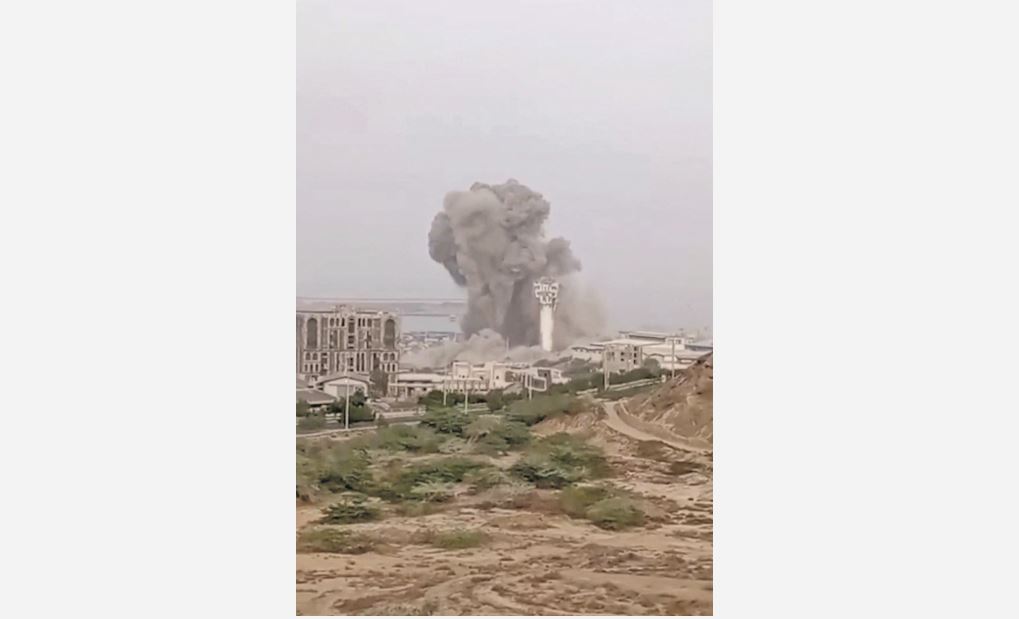
The US struck Iran’s coastal defences and missile sites yesterday after reimposing a naval blockade of its ports, while Iran threatened to shut off more regional energy exports, saying it was engaged in an ‘existential war’ with America.
The latest escalation comes days after a fragile truce collapsed, raising the spectre of a return to full-scale war, though analysts generally see that as less likely.
Hostilities have intensified since Iran said late on Saturday it had closed the Strait of Hormuz.
Military operations are also keeping ships from transiting the vital artery, which carried about a fifth of global oil and gas shipments before the war. Brent crude oil, the international benchmark, closed at a one-month high at $84.95 a barrel yesterday.
US Central Command said the military had attacked coastal defence systems and cruise missile storage and launch sites on Iran’s Greater Tunb Island starting around 6am EDT (1000 GMT), and had completed the wave of strikes within around 90 minutes. Nine hours later, Central Command reported a second wave of strikes.
“The strikes are targeting Iranian military capabilities used to threaten vessels freely transiting through the Strait of Hormuz, an international waterway vital to global commerce.
“The US military is holding Iran accountable at the Commander in Chief’s direction,” Central Command said on X.
Three US officials told Reuters that U.S. strikes aimed at forcing open the strait are also targeting Iranian military capabilities the US would want to destroy before executing more complex operations.
Following the latest round of strikes, Iran’s Mehr news agency said four locations around the city of Ahvaz came under attack, just inland from the northern end of the Gulf, as did Bandar Abbas, Iran’s principal port city on the Strait of Hormuz. In neither case were casualties reported, Mehr said.
Iran’s Tasnim news agency said explosions were heard in Konarak city, at the southern end of Iran on the Gulf of Oman.
Nonetheless, Iranian state broadcaster IRIB reported the US attacks struck near a hospital in Ahvaz that houses a paediatric cancer centre, forcing the temporary evacuation of the hospital. Families have come out to the streets around the hospital to care for their children, IRIB said.
Following the first wave, which Iran said hit a location on its Hengam Island in the strait, Tehran’s top negotiator Mohammad Baqer Qalibaf issued a statement declaring that Iranian security depended on maintaining what he called ‘Iranian arrangements’ in the strait.
“We are in an essential and existential war with America,” Qalibaf said.
The war has killed thousands of people and displaced millions, mainly in Iran and Lebanon, where conflict restarted between Israel and Hizbollah.
Trump struck a triumphant note, as he has repeatedly since the US and Israel started hostilities on February 28, saying, “We’ll have Iran defeated soon. They’ll be defeated very soon.”
Speaking at a roundtable event at the Pennsylvania Defence and Innovation Summit, Trump also claimed the Iranians want to ‘settle so badly’.
“They don’t like what we’re doing, and they do want to settle. We’ll find out whether or not we settle with them, or we just finish it off,” Trump said.
On Tuesday, Trump said US negotiators had been in touch with their Iranian counterparts to tell them ‘you better make a deal’.
Iran has been trying to assert permanent control over shipping in the Strait of Hormuz and to impose fees on vessels passing through it, in what would be a major shift in the balance of power in a region.
The Islamic Revolutionary Guard Corps said yesterday it had struck targets in the region, including in Bahrain, Kuwait and Jordan. Kuwait said its armed forces intercepted four missiles and 21 drones from Iran, but that no injuries or material damage were reported. Bahrain said its defences had intercepted several air attacks.
An interim ceasefire deal signed last month was meant to lead to further negotiations including on Iran’s nuclear programme, and to a permanent truce, but a return to talks has faltered.
“We have no plans for negotiations at the moment and are focused on defence,” Tasnim news agency quoted Iranian foreign ministry spokesperson Esmaeil Baghaei as saying.
Qalibaf, who is also speaker of Iran’s parliament, said that if Iran did not benefit from its memorandum of understanding with the US, ‘we have no reason to adhere to such an understanding’.
UN Secretary General’s spokesperson said António Guterres is deeply concerned by the continuing military escalation.
Guterres ‘calls on all parties to take immediate steps for de-escalation and return to the path of dialogue and diplomacy’, the spokesperson added.
“The secretary-general reiterates that a return to full-scale hostilities would exact an intolerable toll on civilians and have catastrophic consequences for international peace and security and the global economy.
He said the secretary-General reiterates his call for the full restoration of international navigational rights and freedoms in and around the Strait of Hormuz. The exercise of navigational rights and freedoms must be respected by all parties in accordance with international law.
&uuid=(email))