

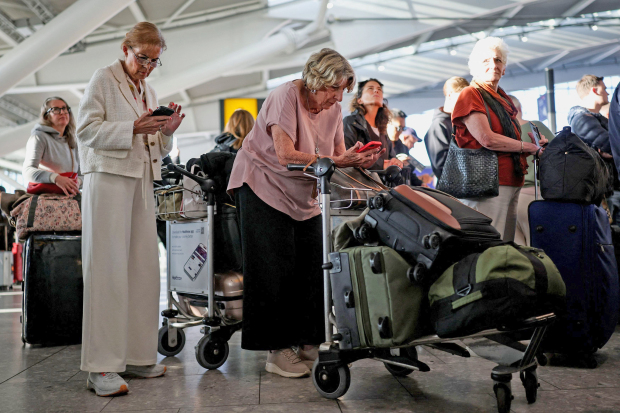
Flights at major British airports were disrupted yesterday by a technical fault at air traffic control provider NATS, the latest in a series of failures that renewed questions about the resilience of Britain’s aviation infrastructure.
The cancellation of hundreds of flights and delays to hundreds more renews scrutiny on NATS three years after a flight-plan processing failure caused even more widespread disruption.
As passengers waited for information in departure halls across the country yesterday, airlines questioned whether the country’s air traffic control system was fit for purpose.
NATS said that the issue has been resolved. It had earlier said that “safety was not compromised.”
“Recovery from system issue has taken longer than we had hoped. Our system issue is now resolved, we are operating normally and working as hard as possible to clear the backlog of flights,” NATS said on X.
Close to a thousand flights were disrupted yesterday, including to and from the largest UK airport, Heathrow.
Data on flight-tracking platform FlightAware said some 490 departures were delayed at six airports, including Heathrow, Gatwick, London City, Luton, Edinburgh and Bristol.
Some 525 arrivals at those six airports were either cancelled or delayed, the website data showed.
However, there was no information on any disruption of Gulf Air flights from Bahrain to UK.
At Heathrow, 38 of 661 scheduled arrivals had been cancelled or were unable to operate, according to aviation analytics company Cirium.
British Airways was the most affected carrier at the airport, cancelling 16 of 333 scheduled departures.
Air traffic control is a tightly timed system in Europe’s extremely busy skies.
Aviation analyst John Strickland said the consequences of even a relatively short outage can be severe because delays quickly cascade through tightly scheduled airline networks.
“A few hours of outage may on the face of it sound limited but the impact is enormous when a substantial number of airports across the UK are affected,” Strickland said.
Ryanair Chief Operating Officer Neal McMahon said more than 65,000 of its passengers had been affected by delays of up to eight hours and that it had cancelled more than 50 flights, calling on NATS CEO Martin Rolfe to resign.
Wizz Air also called for urgent reform of the air traffic controller, saying airlines, passengers and airports should not continue to bear the consequences of recurring system failures.
“A critical national infrastructure provider should not repeatedly bring the aviation system to a standstill. NATS is simply not fit for purpose in its current form,” Wizz Air said.
&uuid=(email))