

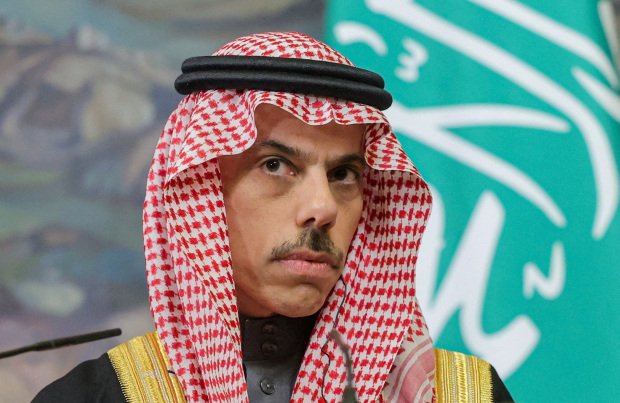
Saudi Foreign Minister Prince Faisal bin Farhan said yesterday that the kingdom would not hesitate to defend itself against any attacks, stressing that it would use all available means to protect its interests while keeping the door open to diplomatic solutions in dealing with the Iran-backed Houthi militia.
Yemen’s Iran-backed Houthis have attacked four cities in Saudi Arabia, wounding more than 70 people and setting oil installations ablaze in what appeared to be a significant expansion of the Middle East war.
Prince Faisal said Saudi Arabia ‘will not hesitate to support what serves the interests of Yemen and the region’, emphasising that the kingdom would use all available means to protect its interests and defend itself against attacks.
Speaking about the Houthi attacks targeting civilian and economic targets, the Saudi foreign minister warned that the militia had embarked on a course of action whose consequences it will not be able to handle, arguing that it was attempting to export its internal problems in Yemen to Saudi Arabia.
He added that the Houthis resort to violence whenever they find themselves in a difficult position, saying the militia insists on imposing further suffering on the Yemeni people rather than engaging responsibly in the political process.
Nevertheless, Prince Faisal stressed that the path to diplomacy in dealing with the Houthis remained open, reaffirming that political solutions were still possible.
He said Yemen’s internationally recognised government had provided an opportunity for responsible negotiations with the Houthis, but that the militia preferred to prioritise its own narrow interests over those of Yemen and its people.
Earlier, the official Spokesman for the Coalition to Support Legitimacy in Yemen Major General Turki Al Malki had said that the escalation by the Houthi militia ‘is a dangerous escalation that confirms the hostile and irresponsible approach of this terrorist militia’.
Al Malki said that the Joint Forces Command of the Coalition will take the necessary operational measures to deter the militia and confront its hostile approach.
Saudi Arabia’s foreign ministry expressed in a statement the kingdom’s strongest condemnation and denunciation of Houthi’s targeting of civilian and economic sites in Abha, Khamis Mushait, Jazan and Najran and the injuries that were inflicted as a result.
The ministry also condemned the militia’s continued targeting of commercial vessels in the Red Sea and its threat to freedom of international maritime navigation.
Saudi Arabia underscored its right to take all measures to protect its sovereignty, territory and national interests, noting that it will take any attack lightly, calling for an ‘immediate halt to all forms of escalation practiced by this militia’, the ministry said.
US Secretary of State Marco Rubio slammed Yemen’s Houthis as ‘agents’ of Iran after the attacks by the militia.
“The Houthis, in many ways, are agents and proxies of the Iranians,” Rubio said.
“I think behind some of this is clearly the Iranian hand,” he told reporters before boarding a flight to Latin America.
Rubio hailed the ‘very strong’ defensive military ties between Washington and Riyadh, adding that the US was watching these events very closely.
He also cited ground operations inside Yemen, where the Yemeni military is taking on the Houthis, and ‘pushing back against some of the ground advances that they [the Houthis] attempted to make’.
GCC Secretary-General Jasem Mohamed Al Budaiwi said the attacks are a blatant violation of international laws and norms, a complete disregard for the safety of civilians, and threaten regional and international security.
He said the repeated assaults also reveal the Houthi group’s intentions and its rejection of efforts to achieve peace and stability in Yemen.
“Targeting civilian installations and national capabilities is a condemned terrorist act that cannot be justified or tolerated under any pretext,” Al Budaiwi stated. He called on the international community to hold the perpetrators and their backers accountable for their actions.
The GCC official reiterated the group’s solidarity with Saudi Arabia and said member states stand united with the kingdom against threats to its security, stability, sovereignty and national capabilities.
In a statement, Kuwait’s government said the attacks are ‘a flagrant violation of the kingdom’s sovereignty’.
It also condemned the Houthi militia’s continued targeting of commercial ships in the Red Sea, which it said constitutes a direct threat to the security and safety of maritime navigation, global energy supplies, and international trade.
The Egyptian foreign ministry said: “Egypt stands with Saudi Arabia against any threat to its security and sovereignty, condemning the missile and drone attacks on four southern Saudi cities.”
Qatar also condemned the Houthis for the attacks, calling them “a reprehensible act of aggression.”
Lebanese President General Joseph Aoun stated: “We in Lebanon are following with utmost concern this dangerous escalation that targets the security and stability of Saudi Arabia, and we strongly condemn this aggressive act.
Pakistani Prime Minister Shehbaz Sherif released a statement on his X account condemning the ‘cowardly’ Houthi attack on the Kingdom, saying” Pakistan stands in unwavering solidarity with the Custodian of the Two Holy Mosques King Salman bin Abdulaziz Al Saud, Crown Prince and Prime Minister Prince Mohammed bin Salman bin Abdulaziz Al Saud, and the brotherly people of Saudi Arabia.
“Such dastardly attacks threaten innocent lives as well as regional peace and security. We reaffirm our steadfast support for the Kingdom’s sovereignty, security and territorial integrity, and pray for the swift recovery of all those injured.”
In a statement released by the foreign ministry, the UAE affirmed ‘these attacks constitute a flagrant violation of the sovereignty of the kingdom, and a threat to its stability and security’.
Condemning the attacks, Sudan’s foreign ministry described the attacks as a threat to the kingdom’s security, the safety of its territory and citizens, and the security and stability of the region.
The government of Sudan affirmed its full solidarity with the Kingdom, its leadership, government, and people, in the face of any threats to its security, sovereignty, and stability. It also upheld the kingdom’s right to take necessary measures to protect its territory and citizens in accordance with international law.
&uuid=(email))