

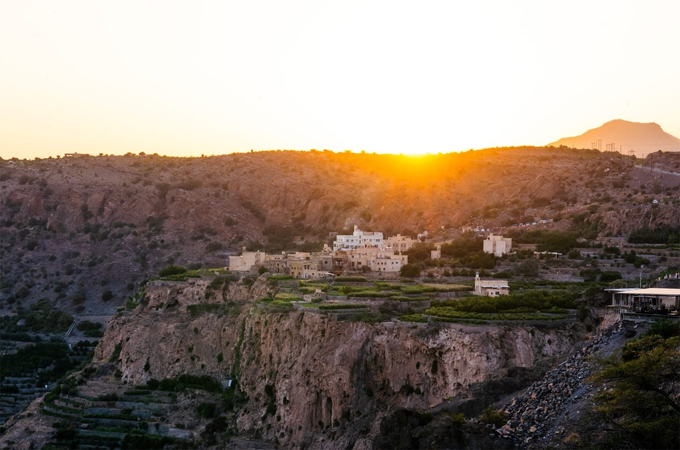
Al Jabal Al Akhdar is preparing to strengthen its position as a leading Gulf tourism destination after being selected as the Capital of Gulf Tourism for 2027, building on its natural, agricultural, cultural and heritage attractions and growing tourism infrastructure.
The designation comes as tourism activity expands in the
wilayat.
Data from Oman’s National Centre for Statistics and Information showed that Al Jabal Al Akhdar welcomed about 101,608 visitors in the first half of 2026.
Hotel establishments generated approximately RO7.8 million ($20 million) in revenue by the end of July, while 44,365 guests were recorded and occupancy reached 32.1 percent.
Sheikh Mahmood Rashid Al Saadi, Wali of Nizwa and Acting
Governor of A’Dakhiliyah, affirmed to Oman News Agency (ONA) that the
designation provides an opportunity to strengthen Al Jabal Al Akhdar’s position
on the Gulf tourism map and support wider economic and investment development
in the governorate.
Preparations for 2027 are focused on improving tourism
experiences, expanding year-round activities and increasing visitor stays and
spending.
Authorities also aim to create greater opportunities for
small and medium enterprises (SMEs), entrepreneurs, craftspeople and farmers to
participate in tourism-related economic activity.
Al Jabal Al Akhdar offers a diverse tourism portfolio,
including its mountainous landscape, mild climate, agricultural production,
heritage villages, aflaj irrigation systems, historical sites, hiking trails
and traditional cultural practices.
These assets provide opportunities for rural, agricultural,
environmental and adventure tourism.
According to Issa Saleh Al Subihi, Director of the SMEs
Development Authority (Riyada) Department in A’Dakhiliyah, the wilayat has 246
SMEs, 11 craftspeople and 44 craft registers.
The growing tourism sector could support businesses in
accommodation, hospitality, restaurants, cafés, transportation and tourism
experiences, while creating markets for agricultural and handicraft products.
Agriculture remains central to the area's identity, with
products including pomegranates, olives, saffron, roses, aromatic plants and
commercial fruits.
Fourteen investment agricultural projects cover about 166
acres, with a combined investment value of approximately RO3.5 million.
Infrastructure development is also progressing, with
projects worth more than RO5.7 million.
These include road improvements, public facilities and
health and administrative services.
Consultancy work for the dualization and development of the
wilayat's five-kilometre entrance road is 90 percent complete, while planning
for an investment park is 50 percent complete.
A major proposed development is the Al Jabal Al Ali project,
valued at up to RO1.2 billion.
Planned across 11.8 square kilometres at an altitude of
about 2,400 metres, it is designed to accommodate around 10,000 residents, with
more than 2,500 residential units, 2,000 hotel rooms and tourism,
entertainment, cultural and sports facilities.
Recent projects include the 20,000-square-metre Al Jabal Al
Akhdar Public Park and seven kilometres of internal roads.
Officials and municipal representatives stressed that local
participation and environmental and cultural preservation will be essential to
maximizing the 2027 designation.
Efforts will therefore focus on improving visitor services
while protecting the mountains, trees, aflaj, agricultural terraces and
heritage that define Al Jabal Al Akhdar.
&uuid=(email))