

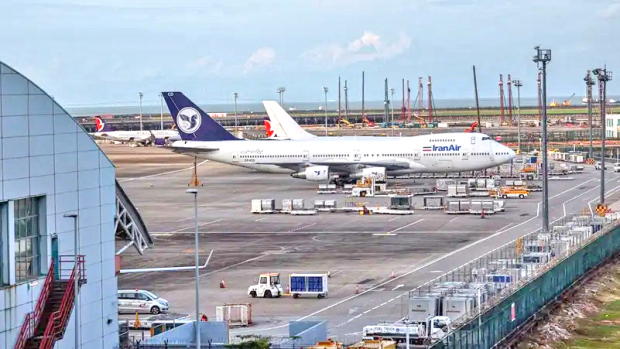
Iranian airlines were barred from neighbouring countries including the UAE and Oman yesterday in response to new US sanctions, the first big impact of a shift in US policy to target companies in third countries that do business with Iran.
The General Civil Aviation Authority of the UAE, the Middle East’s biggest travel hub, said that as a result of the new US policy it was suspending all flights by Iranian airlines until further notice.
Iran’s Tasnim news agency reported that authorities were working to route flights to another Iraqi airport, in Najaf.
Washington had announced it would put sanctions on any global companies doing business with Iranian airlines after Wednesday, with the aim of grounding Iran’s entire civil fleet worldwide.
Other countries in the Gulf region also appeared to have restricted flights.
Tehran’s Imam Khomeini Airport listed scheduled arrivals and departures yesterday to and from countries including Afghanistan, Armenia, China, Iraq, Pakistan, Tajikistan and Türkiye. But no flights appeared to be listed to or from the nearby Gulf states, with which Iran has long had some of its most important business and travel ties.
Iran has suggested that enforcement of a US-mandated air blockade would lead to potential escalation. On Wednesday, a senior Iranian official threatened to make airports ‘unusable’ in any regional country that abides by the US ban.
A flight ban, if sustained, could deepen Iran’s isolation and worsen an economic crisis in the country, which is already facing a US blockade of its ports at sea.
“We are living in an open-air prison,” a retired teacher in Tehran told Reuters by text message on condition her name not be used.
The war, which US President Donald Trump launched alongside Israel in February as “Operation Epic Fury”, has disrupted global energy supplies, killed thousands of people and pushed up oil prices.
Meanwhile, US and Iranian negotiators in New York are exploring a phased path out of war that would involve Tehran reopening the Strait of Hormuz and Washington lifting its economic blockade of Iran, sources close to the talks said.
The talks face a big obstacle as neither side wants to be the first to surrender its leverage, according to comments to Reuters by two Iranian sources, two regional officials and two Western diplomatic sources, but behind Iran’s stance is a recognition of the economic cost of prolonged confrontation.
A senior Iranian official said the most plausible way to end the impasse would be a phased arrangement, with Iran allowing navigation through Hormuz in return for the US lifting its economic blockade and Tehran potentially gaining access to frozen assets.
That would involve Trump accepting another temporary fix, after an earlier understanding collapsed in July. So a central challenge facing the negotiators is not just to sketch out a deal but also to ensure any concessions are durable enough for both sides to trust, the sources said.
l France will send troops and defence systems to Saudi Arabia to help protect the Red Sea port city of Yanbu which is key for energy transport, French President Emmanuel Macron said yesterday.
“This is the agreement we have finalised with the Saudis: we are going to send military resources, that is to say, soldiers, radar systems and defence systems, to protect this site – not to get us involved in any conflicts, but to protect this site,” Macron said in an interview with TF1 and France 2 TV.
&uuid=(email))