

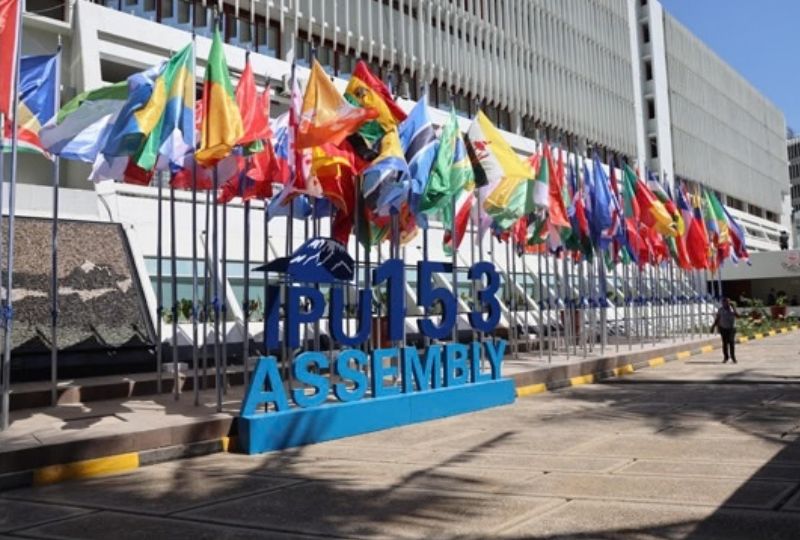
The Kingdom of Bahrain’s parliamentary division delegation and the Inter-Parliamentary Union (IPU) signed a funding agreement to contribute to developing and advancing the IPU’s work in legislation and oversight related to artificial intelligence (AI).
The agreement reflects Bahrain’s interest in establishing legislation regulating AI technologies and their uses, and growing international parliamentary attention to the need for legislative institutions to keep pace with rapid developments in this field and establish legal frameworks that ensure AI is used safely and responsibly, while maximising its potential and limiting associated risks.
The agreement coincided with a statement issued by Dr Tulia Ackson, President of the IPU and Member of the National Assembly of the United Republic of Tanzania, and several international parliamentary leaders on AI and its uses. The statement stressed the importance of parliaments assuming responsibility for regulating and governing AI and establishing frameworks and safeguards defining the limits of its use and levels of risk.
It affirmed that decisions concerning the development of AI and its impact on rights, freedoms, security and society should not be left solely to developers or commercial interests, but require public discussion and democratic deliberation leading to clear legislative rules that direct AI towards serving the public interest and protecting society from its risks.
The statement emphasised the importance of legislative work playing an advanced role in regulating AI use in civilian areas and those related to cybersecurity, defence and warfare, as well as its impact on energy, jobs, information and privacy, national and international security, and compliance with international humanitarian law. It noted that this position does not constitute opposition to AI itself.
The statement also affirmed that industry alone cannot determine societal risks, stressing that societies have the right to know who controls AI, who benefits from it and who bears responsibility if things go wrong because of AI, particularly in light of recent global political and military developments that have raised fundamental questions about who has the right to determine the direction of AI development and the rules governing it.
It explained that regulating AI does not mean choosing safety over innovation, noting that parliaments have a long history of setting limits through legislation, exercising continuous oversight of governments and the private sector, and engaging positively with society.
It cited aircraft safety standards and drug testing before medicines reach patients as examples of regulation that did not prevent progress, but made it safer and more trustworthy.
It also affirmed that legislative institutions in every country should engage the public in discussions on the risks and opportunities associated with AI, build collective capacity to objectively understand and assess its impacts, and review existing laws in light of emerging AI capabilities, particularly in cybersecurity, critical infrastructure, privacy, discrimination, public safety, defence and international security.
The statement called for strengthened parliamentary efforts and cooperation among parliamentarians at the national and international levels to establish boundaries that AI should not cross and strengthen the legal framework governing the technology. It was endorsed by Dr Ackson, Anda Filip, IPU Secretary General, and a number of senior parliamentary figures from several countries.
&uuid=(email))