

Bahrain is hoping to attract investments and regional experts in cheese production and manufacturing of aircraft components, smartphones, lab equipment, pharmaceutical products, glass bottles and containers, carbon electrical products, cables and car tyres.
At the ‘Made In GCC’ forum, which concluded yesterday at Exhibition World Bahrain, the Industry and Commerce Ministry (MOIC) highlighted these segments as areas in which Bahrain offers strong opportunities with a wishlist that looks set to become a reality.
“We have identified 12 sectors in which we import products worth $2 billion, including vehicle manufacturing, semi-conductors and cheese,” an official from the MOIC told the GDN.
“After Covid-19 and the war, we identified gaps within food and pharmaceuticals, which we want to fill. We also have strong industries which we want to leverage to reduce our import burden.”
Approximately BD20.7 million of hard and semi-hard cheese is currently imported to Bahrain, however the kingdom has no local producers.
The MOIC noted that the kingdom’s central Gulf location and advanced food and logistics infrastructure make it an ideal location for fermentation, cutting and packaging facilities.
“Bahrain is poised to become a regional hub for premium cheese manufacturing and distribution across the GCC and wider Middle East,” the ministry noted at its booth in the exhibition area of the forum.
Bahrain also currently imports BD268m of aircraft components and the kingdom is hoping to offset this import with local manufacturing, according to the MOIC.
Another opportunity for investors, with no local production competition, is the manufacture of pharmaceutical products. Currently Bahrain imports BD76.4m of pharmaceutical products.
“Bahrain presents a strong opportunity to expand local pharmaceutical manufacturing and packaging capacity,” the MOIC added. “With rising domestic demand for retail-ready medicines, the kingdom can attract contract manufacturing (CMO) partnerships and technology transfer projects to localise high-quality production.
“This approach strengthens national pharmaceutical security, enhances self-sufficiency, and positions Bahrain as a trusted regional hub for medicine manufacturing and packaging.”
Bahrain also imports BD178m of smart devices, including smartphones, laptops and network devices. The kingdom could leverage its industrial zones and advanced digital infrastructure to assemble key components, according to the MOIC.
Another highlighted opportunity for businesses looking to invest in Bahrain was the manufacture of buses and small cars, currently valued at BD58.1m of imports.
“Bahrain offers a compelling opportunity in vehicle manufacturing and assembly – from large public, school, and tourist buses to compact passenger cars (1.0-1.5L engines),” the MOIC added.
“Strategically located at the heart of the Gulf, Bahrain combines world-class logistics and strong regional trade agreements to enable efficient Completely Knocked Down (CKD)/Semi-Knocked Down(SKD) assembly operations.
“With growing production of key components – including chassis, seats systems, glass, and tyres – Bahrain is rapidly emerging as a competitive hub for regional supply and export to the GCC and wider Middle East.”
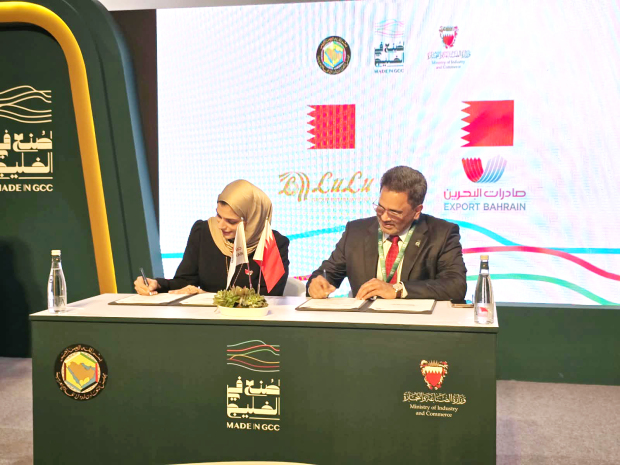
On the side lines of the conference, several Bahraini and GCC companies and organisations signed Memoranda of Understanding (MOUs) to explore collaboration and investment opportunities in the near future.
Amongst these was LuLu Group International which signed an MoU with Export Bahrain to showcase more local Bahraini products at its retail outlets.
In total, 10 MoUs were signed during the two-day forum that concluded yesterday.
naman@gdnmedia.bh
&uuid=(email))