

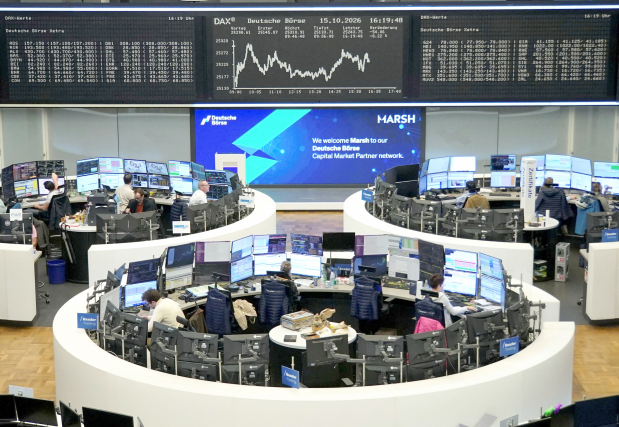
Global stocks edged lower yesterday as markets stabilised after a sharp tech-led selloff, while the dollar headed for a weekly loss.
Markets have been rattled this week by concerns over higher interest rates and the debt-fuelled financing behind the AI boom, triggering a selloff in technology and chip stocks.
Traders increased bets on further US rate hikes after stronger-than-expected inflation data on Wednesday, while investors piled into Treasuries and other government bonds.
On Wall Street, the benchmark S&P 500 and the Nasdaq were trading down and were headed for weekly losses. The Dow was flat but set for a weekly gain.
Technology and communication services were driving losses while top gainers were utilities and consumer staples stocks.
CoreWeave’s shares shed 9 per cent on the day and were on track to lose nearly 23pc this week amid increasing investor scrutiny of the financing for the massive AI infrastructure buildout.
The Dow Jones Industrial Average rose 0.01pc, the S&P 500 fell 0.61pc, and the Nasdaq Composite fell 1.3pc.
The MSCI World Equity Index lost 0.10pc and was set for a weekly loss. European stock indexes, hit less hard by Thursday’s selloff, were higher, with the STOXX 600 up 0.67pc. London’s FTSE 100 rose 0.38pc.
“We’re starting to see some cracks in the financing of data centers because you’re not too sure who’s going to be the winners,” Tom Plumb, portfolio manager at Plumb Balanced Fund, said.
“Our view is that there’s going to be some really significant winners. But you have to be careful on the financing capability because companies don’t get into trouble because their assets don’t exceed their liabilities. They get into trouble when they have liquidity issues.”
Asian stocks mostly rose and bond markets steadied yesterday, with investors reversing some of the previous session’s moves.
Indonesian equities suffered their biggest drop since 1998 after index provider MSCI said the country’s market no longer merited emerging-market status and outlined plans to remove it from key indexes tracked by funds.
The dollar index fell 0.23pc and was on track for its first weekly decline after four weeks of gains, as lower Treasury yields reduced the currency’s appeal. Further worries about AI would push the dollar down further, analysts said.
The euro rose from its recent 17-month low. It was last up 0.10pc at $1.1232.
The Japanese yen strengthened 0.04pc against the greenback to 157.92 per dollar.
European government bond yields edged higher, while US bond yields fell. Germany’s 10-year yield rose 0.14 basis point to 3.411pc. The yield on benchmark US 10-year notes fell 0.17 basis points to 5.085pc.
Even so, yields have eased this week as investors sought the safety of government debt amid concerns about AI-related companies’ finances. G7 government bond markets were on course for their strongest weekly performance since late May.
Brent crude futures rose 0.85pc to $106.83 a barrel and were headed for a second straight weekly gain amid concerns over Middle East supplies. Attacks around the Strait of Hormuz have surged in the past 10 days.
Gold gained support from the weaker dollar, rising 0.17pc to about $4,177.14 an ounce.
Meanwhile, stock market in the UAE closed higher yesterday, in line with global equities, with Dubai outperforming its regional peer as investors assessed geopolitical developments and focused on diplomatic solutions.
Dubai’s main index recovered from losses in the previous session, rising 0.6pc, supported by gains in utility and financial stocks.
Emirates NBD Bank, Dubai’s largest lender, advanced 2pc, while Dubai Electricity and Water Authority climbed 1.9pc.
Separately, Dubai Chambers signed memoranda of understanding with four Chinese chambers of commerce to strengthen cooperation, support the business community, and deepen ties between companies in Dubai and their counterparts in Beijing, Shenzhen, Guangzhou and Chongqing.
Abu Dhabi’s benchmark index edged 0.04pc up, helped by a 2.9pc rise in Americana Restaurant International and 1.8pc hike in hospitality firm Abu Dhabi National Hotels.
Among the gainers, Fujairah Cement Industries rose 1.1pc after its board approved a tripartite partnership project to establish and operate a dry mortar and chemicals plant.
Dubai’s index posted a weekly gain of 0.8pc after two consecutive weeks of losses, while Abu Dhabi’s index also ended a three-week losing streak, recording a marginal weekly increase of 0.13pc.
&uuid=(email))