

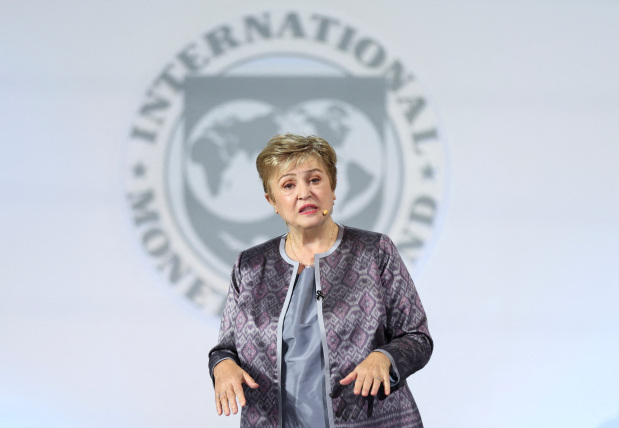
THE global economy is showing great resilience but there is no room for complacency, the head of the International Monetary Fund’s steering committee said yesterday, while divisions over Russia’s war against Ukraine sparked a walkout of delegates.
Saudi Finance Minister Mohammed Al Jadaan, who heads the IMF’s steering committee, asked about the walkout by nearly half of delegates during remarks by Russia’s finance minister at a meeting yesterday, said the important thing was that members ultimately agreed to the chair’s statement.
“We came here for a reason, and we achieved it. Look at this chair statement, it clearly says that all members agreed to the statement, so that’s what matters,” the chair of the International Monetary and Financial Committee told Reuters.
Al Jadaan told a Press conference that the global economy was demonstrating “remarkable resilience” in the face of profound ongoing challenges, including wars, threats to energy and food security, high public debt levels, and risks linked to the rapid development of artificial intelligence, while warning finance officials against letting down their guard.
“The message from the IMFC members is clear: There is no room for complacency,” Al Jadaan said in the final press conference of a week of IMF and World Bank annual meetings that brought more than 18,000 people to Bangkok.
Fiscal authorities should work to rebuild buffers while protecting vulnerable populations and growth-enhancing investments, Al Jadaan told reporters, underscoring the need for continued central bank independence and policies that supported private sector-led growth and investment.
He said IMFC members called for increasing support to countries that are facing short-term financing challenges caused by spillovers from wars and high energy prices.
“International cooperation remains critical to addressing excessive global imbalances and trade tensions,” he said.
IMF Managing Director Kristalina Georgieva called the meetings productive but said there was clearly heightened anxiety among members about increasing divergence.
Many lower income countries that were not part of the AI-value chain feared they were falling behind, she said.
“These meetings also have shown that in a world of repetitive shocks and geopolitical fragmentation, still there is desire for multilateral dialogue and cooperation,” she said.
The Development Committee, which groups the boards of both the World Bank and the IMF, touched on similar themes in its statement, underscoring the urgent need to end wars and conflicts to ensure sustainable growth and long-term stability.
“Our priority remains to promote macroeconomic and financial stability while enabling broad-based, private sector-led growth, and strengthening resilience through credible policies and international cooperation,” the committee’s chair, Swedish Finance Minister Elisabeth Svantesson, said.
Those comments came shortly after many IMFC delegates left the room when Russian Finance Minister Anton Siluanov addressed the group in Russian.
Bundesbank President Joachim Nagel told a bank event on the sidelines of the meetings that nearly 50 per cent of delegates took part in the walkout, sending a clear message to Russia.
“This is a very strong signal about solidarity and values. It would be the best for the world economy if this unprovoked war of aggression against Ukraine would end,” Nagel said. “I was really proud so many left this plenary.”
Ukraine’s central bank chief, Andriy Pyshnyi, told Reuters he was surprised by the large number of finance officials who left the room, calling it a “deep and emotional moment.”
The Bank of England confirmed that Governor Andrew Bailey was among the delegates who joined the walkout, which comes ahead of Britain hosting the G20 next year.
&uuid=(email))