

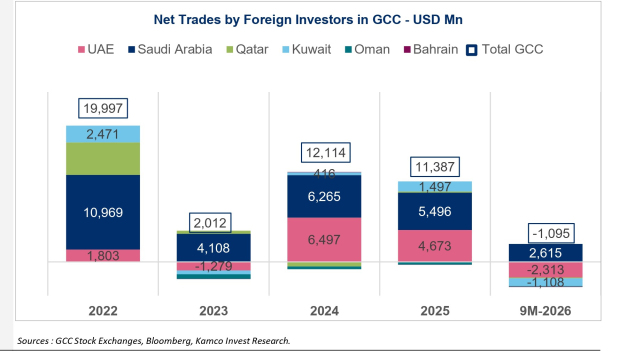
FOREIGN investors extended their net-selling streak across GCC stock markets for the second consecutive quarter during Q3-2026, offloading a record $2.3 billion – the highest level recorded by Kamco Invest since data tracking began in 2019. The figure marks a steep escalation from net sales of $298.3 million in Q2-2026.
According to the quarterly trading data, foreign investors were net sellers across nearly all regional exchanges during the quarter, with Qatar standing as the sole exception by attracting $10.9m in net foreign inflows.
Saudi Arabia saw the heaviest foreign outflows in the region during Q3-2026, registering net sales of $1.5bn and completely reversing the $1.5bn in net purchases recorded the previous quarter.
Dubai followed with foreign net sales of $414.3m, while Kuwait and Abu Dhabi experienced net selling of $284.1m and $36.1m, respectively. Oman and Bahrain recorded more modest foreign net outflows of $26.5m and $21.8m, respectively.
For the first nine months of 2026 (9M-2026), foreign investors were net sellers in five of the nine months, culminating in total net outflows of $1.1bn. This contrasts sharply with the $11.7bn in net buying witnessed during the corresponding period in 2025.
Monthly tracking (excluding Bahrain due to unavailable data) revealed mixed behaviours across member states. Abu Dhabi recorded net foreign buying in July 2026 before shifting to net selling in August and September. In contrast, Qatar saw net selling in July, followed by net buying over the subsequent two months. Oman registered net foreign selling during the first two months of the quarter before turning to net buying in September, while Saudi Arabia, Dubai, and Kuwait suffered consistent, uninterrupted net foreign selling across all three months of Q3-2026.
Reflecting the impact of regional geopolitical developments on corporate earnings and investor sentiment, local investors pivoted to aggregate net buying of $760.7m during Q3-2026, successfully reversing the $921.2m in net selling seen in Q2-2026.
Meanwhile, GCC investors (excluding Bahrain) recorded net buying of $173.9m in Q3-2026, up from $62.4m in Q2-2026. GCC investors directed most of their capital toward Saudi stocks ($323.3m) and Abu Dhabi equities ($27.2m), which helped offset net selling across other regional bourses.
Aggregate GCC trading volumes fell by 12.7 per cent quarter-on-quarter (q-o-q) to 83.1 billion shares in Q3-2026, down from 95.2 billion shares in Q2-2026. Volumes declined across all seven GCC exchanges, led by Bahrain with a 28.3pc drop to 0.14 billion shares, followed by Qatar ( down 18.2pc), Abu Dhabi (down 14.5pc), and Kuwait (down 13.4pc), alongside declines in Saudi Arabia, Dubai and Oman.
In tandem, aggregate trading value dropped by 14.4pc q-o-q to $135bn, compared with $157.7bn in Q2-2026. Saudi Arabia registered the largest absolute drop, with trading values sliding from $86.4bn in Q2-2026 to $73.8bn in Q3-2026, while Dubai saw values contract from $14.4bn to $10.3bn.
Saudi Arabia and the UAE dominated regional trading activity, claiming all spots among the top 10 most-traded stocks in the GCC, which collectively amassed $28.8bn (20.9pc of total regional trade value). Al Rajhi Bank led the regional list with $6.6bn in trading value, followed closely by Aramco with $3.7bn and Emaar Properties at $3.6bn, alongside prominent contributions from Saudi National Bank and Rabigh Refining and Petrochemical.
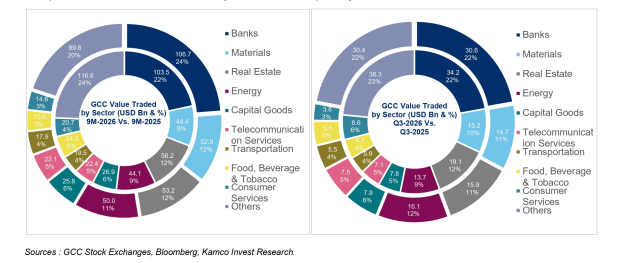
The banking sector captured the largest share of traded value in Q3-2026, despite a 10.6pc decline to $30.6bn, compared with $34.2bn in Q3-2025, anchored by activity in Al Rajhi Bank, Saudi National Bank, and Alinma Bank.
While energy, capital goods, and telecommunication services provided occasional bright spots, overall sectoral performance remained subdued, with seven out of ten sectors recording declines.
Real estate suffered the sharpest contraction at 17pc, followed by transportation (down 7pc) and materials (down 3pc). On a 9M-2026 basis, total traded value reached $448.7bn – a 6.3pc decline from $478.6bn in 9M-2025 – though resilient pillars like banking, materials, and energy services posted strong year-to-date growth of 3.2pc, 19.2pc, and 13.3pc, respectively.
avinash@gdnmedia.bh
&uuid=(email))