

US President Donald Trump said yesterday that Iran has agreed to hand over its store of enriched uranium and that the two sides were ‘close’ to a peace deal to end the war that has engulfed the Middle East.
The US had earlier threatened to resume air strikes on the Islamic Republic and maintain a naval blockade of its ports if Tehran refused to accept a deal to solve the conflict that broke out on February 28.
At the same time, on another front in the conflict, Trump announced that Israel and Lebanon had agreed to a 10-day truce starting yesterday and said he expected the two countries’ leaders at the White House in ‘four or five days’.
Trump said Iran had offered not to have nuclear weapons for more than 20 years. Tehran’s nuclear ambitions were a sticking point at talks in Islamabad last weekend.
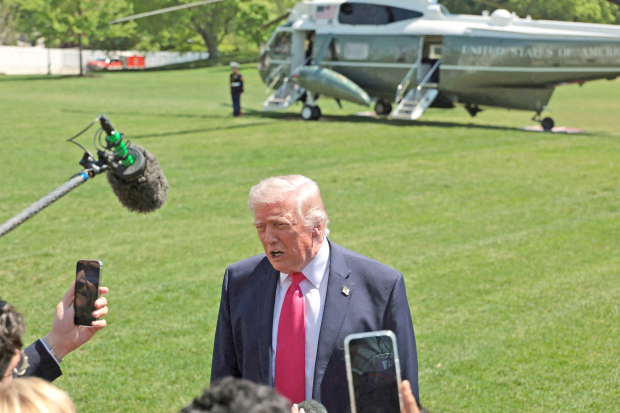
“We’re going to see what happens. But I think we’re very close to making a deal with Iran,” he told reporters outside the White House.
“I think we have a chance. And if that happens, oil goes way down, prices go way down, inflation goes way down, and ... much more importantly than even that, you won’t have a nuclear holocaust.”
Trump said he was not sure a two-week ceasefire agreed with Iran last week would need to be extended beyond next week, and added that Tehran wanted to make a deal.
“We have a very good relationship with Iran right now, as hard as it is to believe. And I think it’s a combination of about four weeks of bombing, and a very powerful blockade.”
He said later that the White House meeting could take place over the next week or two, and that if an Iran deal was reached and signed in Islamabad, he might go for that.
At last weekend’s talks, the US proposed a 20-year suspension of all nuclear activity by Iran – an apparent concession from longstanding demands for a permanent ban. Tehran suggested a halt of three to five years, according to people familiar with the proposals.
Washington has pressed for any highly enriched uranium (HEU) to be removed from Iran. Tehran has demanded that international sanctions against it be lifted. Two Iranian sources said there were signs of a compromise emerging on the HEU stockpile, with Tehran considering shipping part, but not all, of it out of the country, something it had previously ruled out.
A diplomatic source said the key Pakistani mediator, Army chief Asim Munir, arrived in Tehran on Wednesday and had made a breakthrough on ‘sticky issues’, although Tehran said the fate of its nuclear programme had not been resolved. Trump has said the accord would open the Strait of Hormuz.
Trump said in an earlier social media post that the Lebanon ceasefire would start at 5pm (2100 GMT).
He said he had held ‘excellent conversations’ with Israeli Prime Minister Benjamin Netanyahu and Lebanese President Joseph Aoun and planned to invite them both to the White House for ‘meaningful talks’.
Trump said he had directed US Vice President JD Vance, Secretary of State Marco Rubio and Chairman of the Joint Chiefs of Staff Dan Caine to work with Israel and Lebanon to achieve lasting peace.
The war with Iran spilt into Lebanon on March 2, when Hizbollah opened fire in support of Tehran, prompting an Israeli offensive in Lebanon 15 months after the last major conflict.
Thousands of people have been killed, mostly in Iran and Lebanon, since US-Israeli attacks on Iran began on February 28, triggering Iranian air strikes on Iran’s Gulf neighbours and renewed fighting between Israel and Hizbollah.
Soaring energy costs have rattled investors and policymakers globally since Iran effectively closed the Strait of Hormuz, through which a fifth of the world’s oil and gas supply flows.
Closure of the strait has caused the worst oil price shock in history and forced the International Monetary Fund to downgrade its outlook for the global economy, warning prolonged conflict could push the world to the brink of recession.
&uuid=(email))