

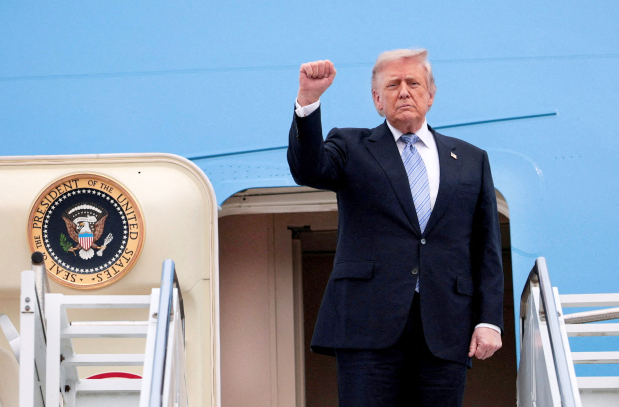
US President Donald Trump left China yesterday with no major breakthroughs on trade or tangible help from Beijing to end the Iran war, despite two days spent heaping praise on his host, Xi Jinping.
Trump’s visit to America’s main strategic and economic rival, the first by a US president since his last trip in 2017, had aimed for concrete results to lift his sagging approval ratings before the November midterm elections.
Xi will visit the US in the fall at Trump’s invitation, China’s Foreign Minister Wang Yi said.
The summit was filled with pageantry, from goose-stepping soldiers to tours of a secret garden.
But behind closed doors, Xi issued a stark warning to Trump that any mishandling of China’s top concern, Taiwan, could spiral into conflict.
During a huddle with reporters on the way back to the US, Trump said Xi told him he opposed Taiwan’s independence.
“I heard him out. I didn’t make a comment ... I made no commitment either way,” said Trump.
He added that he will decide on a pending arms sale to Taiwan shortly, after speaking to ‘the person that right now is ... running Taiwan’.
While Trump searched for immediate business wins, such as a deal to sell Boeing jets that did not impress investors, Xi talked up a long-term reset and pact to maintain stable trade ties with Washington, underscoring their differing priorities.
Xi pushed a new term by describing the relationship as ‘constructive strategic stability’ – a sharp departure from the framing of ‘strategic competition’ used by former US President Joe Biden, which Beijing disliked.
“Until now, China hasn’t proposed an alternative – now they have – if the US side agrees, that is progress,” said Da Wei, director of the Centre for International Security and Strategy at Tsinghua University in Beijing.
A brief US summary of Thursday’s talks highlighted what the White House called the leaders’ shared desire to reopen the Strait of Hormuz off Iran, and Xi’s interest in American oil purchases to pare its dependence on the Middle East.
But just before the leaders met for tea yesterday, China’s foreign ministry issued a blunt statement that supported efforts to reach a peace deal but said the conflict should never have happened and had no reason to continue.
At Zhongnanhai, Trump said the leaders had discussed Iran and felt ‘very similar’, though Xi did not comment.
“What’s notable is that there’s no Chinese commitment to do anything specific with regards to Iran,” said Patricia Kim, a foreign policy fellow at the Brookings Institution.
In another sign of a diminished scale of the summit, Trump’s readout did not mention the broad structural reforms on which previous presidents pressed Xi.
Unlike his previous trip in 2017, Trump did not discuss ‘structural reforms’, ‘global economic governance’ or the ‘international trading system’ with Xi, according to the readout.
Even the deal touted as the biggest single deliverable from the meetings underwhelmed.
Boeing stock fell four per cent when Trump said on Thursday that China would buy 200 Boeing jets, significantly fewer than the roughly 500 that sources told Reuters had been under discussion.
China and the US agreed to establish a Board of Trade and Board of Investment to resolve concerns over market access for agricultural products and expand trade ‘under a reciprocal tariff-reduction framework’, Wang said according to a statement released by his ministry.
The expected move aims to reduce tariffs on non-sensitive goods that can be traded without crossing national security red lines.
Both sides were expected to identify $30 billion of goods.
The agreement marks a shift away from US demands that Beijing change its state-directed economic model and towards numerical trading targets in non-strategic sectors while keeping in place broad tariffs and export controls on sensitive technologies.
US officials said they had agreed deals to sell farm goods, but there were scant details and no signs of a breakthrough on selling Nvidia’s advanced H200 AI chips to China, despite CEO Jensen Huang’s dramatic last-minute addition to the trip.
Trump left without official resolution to the rare earths supply problem that has dogged ties since China imposed export controls on the vital minerals in response to Trump’s tariff barrage in April 2025.
While the leaders struck a truce last October for Washington to lower tariffs in exchange for China keeping rare earths flowing, Beijing’s controls have caused shortages for US chipmakers and aerospace companies.
When asked if the two sides extended the truce beyond later this year, Trump said he and Xi ‘did not discuss tariffs’.
&uuid=(email))