

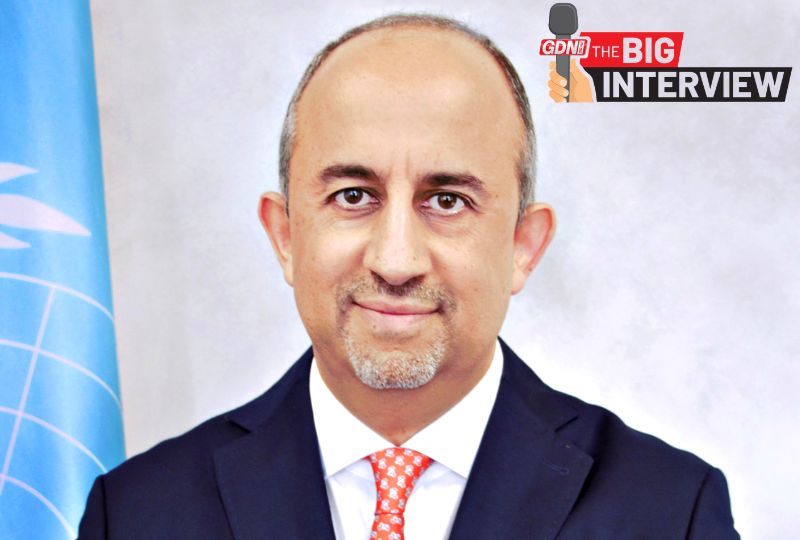
Military and geopolitical tensions in the region could slow down or even reverse progress in sustainable development for Bahrain and the Middle East, according to a top UN official in Bahrain.
Speaking to the GDN, the UN’s resident co-ordinator in Bahrain, Khaled El Mekwad, noted that the ongoing US-Israel-Iran conflict has not changed priorities, with the different UN entities in Bahrain working to deliver critical programmes in close co-ordination with the government, while adding that ‘conflict and sustainable development do not mix well’.
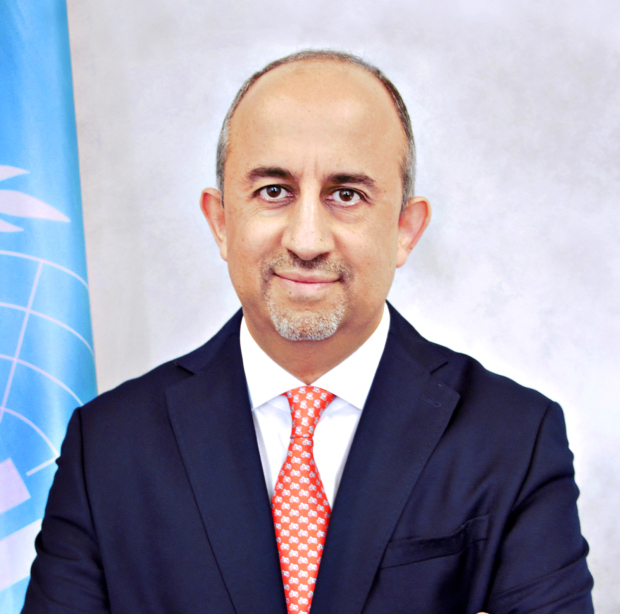
Mr El Mekwad
“In addition to the immediate civilian impact, the military escalation in the Middle East, which the UN Secretary-General (António Guterres) has been condemning since its onset on February 28, constitutes a serious threat to progress in sustainable development for the whole region – Bahrain is no exception,” he added. “Peace is foundational to sustainable development; without it, previous progress can stall or be reversed.”
On May 4, nearly a month into a ceasefire between the involved parties, Iran launched 12 ballistic missiles, three cruise missiles and four UAVs at the UAE. While the majority were intercepted, the drone strikes led to a fire in the Fujairah oil Industry Zone, injuring three civilians and damaging critical energy infrastructure.
Bahrain and the UAE issued a joint statement at the UN, denouncing the attacks from Iran, a member state of the UN.
“The security of the region is indivisible, and such attacks must cease immediately,” Bahrain’s permanent representative to the UN Jamal Fares Alrowaiei noted, in the presence of UAE permanent representative to the UN Mohamed Abushahab. “They require credible, united and decisive response from the international community and particularly from the Security Council.”
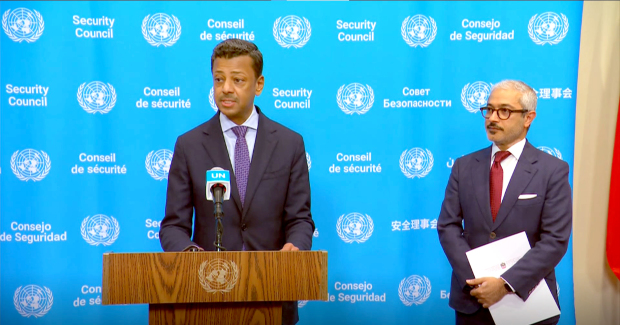
Mr Alrowaiei, left, speaks in the presence of Mr Abushahab
The attacks also damaged facilities in Bahrain prior to the April 8 ceasefire, and killed three individuals, of whom two were civilians.
The conflict has also had an impact on supply chains as well as the overall economy across the GCC.
Mr El Mekwad noted that the government in Bahrain has reacted well to the need of the moment, implementing a series of measures to mitigate the socioeconomic impact of the crisis, including ‘the continuity of essential services, such as health and education, as well as support for businesses, employment, housing and other social services’.
During this time, he clarified that in addition to delivering the regular programmes, UN in Bahrain is ‘ready to support the kingdom’ based on requests by the government.
“The UN and Bahrain have a longstanding partnership aimed at achieving the Sustainable Development Goals in the kingdom, which is today captured in the Co-operation Framework 2025-2029,” Mr El Mekwad added. “This framework charts a shared course towards inclusive development across four priorities: people, prosperity, peace and the planet.
“These are aligned with Bahrain’s Vision 2030 and the 2030 Agenda for Sustainable Development.
“The framework is marked by a strong emphasis on inclusivity, with programmes targeting women, youth and vulnerable groups to ensure that no one is left behind in the pursuit of the Sustainable Development Goals (SDGs).
“In 2025, building on the achievements of past years, we laid the foundations to accelerate SDG progress through inclusive partnerships, economic diversification, climate resilience, and governance reforms.
“Efforts to diversify the economy have been reinforced through green transition initiatives, innovation, and industrial development, while governance reforms have been supported to strengthen justice, transparency and human rights.
“Climate resilience and environmental stewardship have also been central priorities, with projects advancing sustainable urban planning and renewable energy.”
However, the current conflict could slow progress in these areas, although both parties remain committed to pursuing them.
“The UN Secretary-General has strongly condemned the military escalation in the Middle East, including strikes by the US and Israel and retaliatory attacks by Iran, stressing that international law applies universally and must be respected without exception,” Mr El Mekwad added. “He has reminded all parties that Security Council resolutions, including the latest Resolution 2817 (2026), are binding and must be implemented.”
Mr El Mekwad noted that Mr Guterres’ personal envoy Jean Arnault has been engaging with regional stakeholders to explore pathways towards lasting peace.
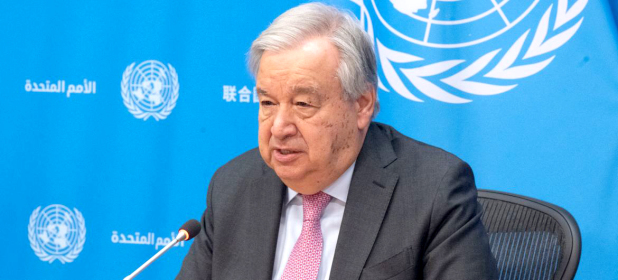
Mr Guterres
To address the socio-economic and humanitarian impact, Mr Guterres has established a Task Force led by the UN Office for Project Services in collaboration with UN Conference on Trade and Development, International Maritime Organisation, and the International Chamber of Commerce tasked with developing mechanisms to facilitate fertiliser trade and ensure the movement of essential raw materials.
The UN has also conducted initial assessments of the conflict, including civilian impact, monitoring violations of international humanitarian law and human rights in general, as well as the socio-economic impact of the war.
It has found that this crisis has caused ‘the most severe global humanitarian supply chain disruptions since Covid-19 and the war in Ukraine’.
“The geopolitical landscape has shifted towards greater instability, with civilians increasingly bearing the brunt of conflict across the Middle East, a region already hosting the world’s largest population in humanitarian need,” Mr El Mekwad added.
“As security and economic shocks spread, humanitarian needs are intensifying, with displacement pressures, service disruptions, and widening protection risks, particularly for women and girls.
“Disruptions to the movement of humanitarian and commercial goods are driving up costs, delaying aid delivery, and threatening food security, health systems and basic supplies across the region.
“Most worryingly, delays and rising costs are slowing lifesaving deliveries to people who cannot wait.
“Safe passage for humanitarian cargo, especially through the Strait of Hormuz, along with unimpeded access, security guarantees, and adequate funding, will be decisive in determining how effectively the UN and its partners can respond to the growing humanitarian impact.”
Countries in the Mena region which are heavily reliant on imported food and agricultural inputs, the shock could aggravate food price volatility and increasing unemployment, straining social safety nets.
Millions in sub-Saharan Africa could be pushed into acute hunger, with the UN World Food Programme warning that if oil prices remain above $100 a barrel and the conflict persists, up to 45m more people globally could fall into acute food insecurity.
In both regions, the ripple effects of disrupted supply chains, rising costs and reduced access to essential inputs could lead to record levels of hunger and malnutrition, undermining development gains.
naman@gdnmedia.bh
&uuid=(email))