

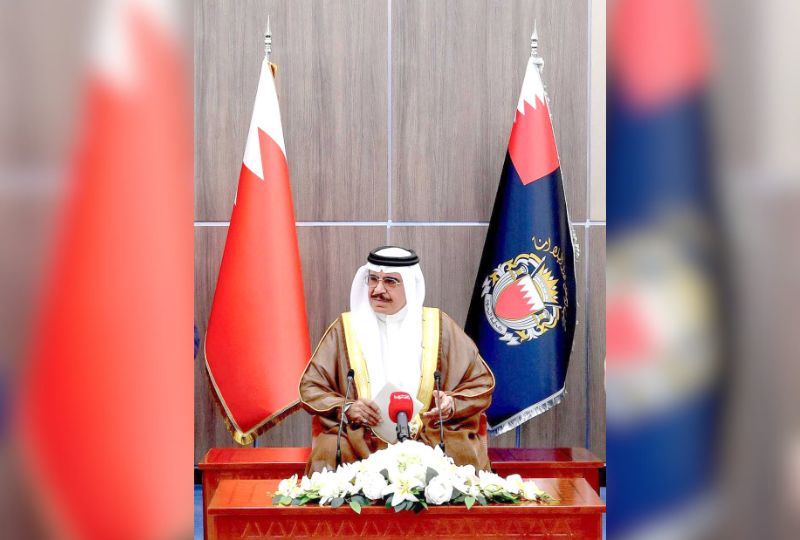
The Interior Minister has long upheld the tradition of meeting heads and officials of ma’atams ahead of the Ashoora season, reflecting the kingdom’s commitment to safeguarding the freedom of religious practice.
This is a tradition that has been passed down through generations in a nation built on religious and sectarian coexistence and tolerance throughout its history.
This year’s meeting comes at an exceptional time amid complex regional circumstances, in which some seek to exploit religious occasions for political purposes or external affiliations that could disrupt Bahrain’s social harmony.
Against this backdrop, the address delivered by Interior Minister General Shaikh Rashid bin Abdullah Al Khalifa conveyed a comprehensive political, security, and social message centred on strengthening national loyalty.
Perhaps the most significant point raised in the minister’s speech was the importance of separating religious observances from political projects.
He emphasised that Wilayat Al-Faqih is a political project in the guise of a religious rhetoric, drawing a clear distinction between Hussaini rituals, deeply rooted in Bahraini society, and the doctrine itself.
He stressed that the state does not oppose the practice of religious rituals or the commemoration of Ashoora, but rather rejects attempts to use the occasion to advance external political agendas or loyalties that go beyond the nation-state.
He noted that ceremonies dedicated to Wali Al-Faqih are prohibited and subject to accountability.
The observance of Ashoora has long been a defining religious tradition in Bahrain.
It predates the concept of Wilayat Al-Faqih, which Iran and its supporters sought to promote following the rise of Ayatollah Khomeini and his followers to power in Iran in the late 1970s.
Over the years, proponents have sought to appropriate the Shiite doctrine to serve their political project.
The Interior Minister also briefed ma’atam leaders on developments related to organisations associated with Wilayat Al-Faqih, as part of efforts to safeguard Bahrain’s national identity against external influence.
By highlighting what he described as attempts at ‘Iranian expansion under the guise of religion’, the minister underscored the responsibility of ma’atams to protect their visitors.
He stressed that their role extends beyond religious functions to include intellectual, cultural, and educational responsibilities aimed at strengthening Bahraini identity.
The message reflects the state’s view that the challenge is not merely posed by individuals or organisations, but by a broader project that seeks to create what the minister termed a ‘parallel patriotism’ — political and ideological loyalties that supersede national allegiance.
For this reason, the speech placed strong emphasis on sovereignty, unified loyalty to the state, and the rejection of dual political affiliations.
From an organisational perspective, the minister’s remarks also offered reassurance regarding the continuation of Hussaini rituals.
He affirmed that the state protects and supports the lawful practice of religious observances, and that regulatory measures are intended to ensure security and public safety rather than to restrict religious expression.
This reflects the state’s commitment to preserving the Ashoora season within its religious and cultural framework, free from political and regional tensions.
At the same time, the contributions by ma’atam leaders during the meeting reflected a shared commitment to preserving Ashoora as a unifying religious and social occasion in Bahrain.
They emphasised that its success depends on continued co-operation between society and the state, adherence to established traditions, the preservation of civil peace and social cohesion, and compliance with laws and regulations governing the season.
This meeting underscores the determination to preserve the sacredness of Ashoora, maintain its spiritual atmosphere, strengthen national unity, and shield the occasion from regional conflicts and political polarisation.
More broadly, its central message extends beyond the organisation of the Ashoora season itself.
It reinforces the concept of the modern nation-state — one that guarantees religious rights and freedoms while safeguarding its sovereignty and stability against external interference or influence.
&uuid=(email))