

Trade finance and treasury often operate behind the visible side of banking, but their importance comes to the fray when an importer needs a guarantee, a company seeks liquidity from several lenders, or a rapid movement in interest and foreign exchange rates changes the economics of a transaction.
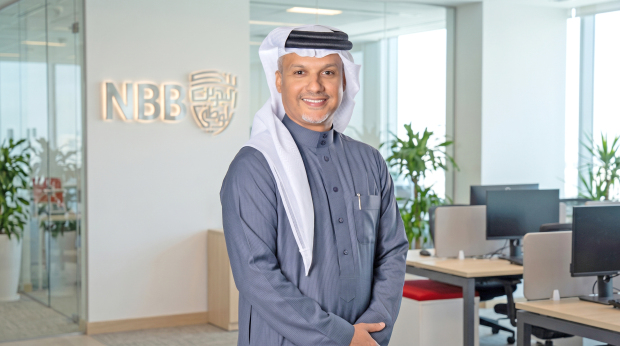
As Group Chief Executive – Markets and Client Solutions at the National Bank of Bahrain (NBB), Husain Almohri works at the point where these needs meet. His remit brings together cross-border trade, regional financing relationships, treasury expertise, and the liquidity required to keep businesses operating through changing conditions.
The role demands technical capability, though Mr Almohri’s description of it is rooted in something more fundamental. NBB’s responsibility, as he sees it, is to help Bahraini companies transact with confidence at home and abroad, and to remain steady when the wider environment becomes harder to read.
Enabling cross-border commerce
Trade finance is the part of Mr Almohri’s remit most directly tied to everyday business activity. Its instruments support different points in the commercial cycle, from assuring payment and performance to managing working capital between buyers and suppliers.
“We help companies reduce trade risks, improve cash flows and support the continuity of their businesses,” he says.
Continuity is a central expectation in this context. Reliable trade finance allows a company to plan expansion, manage sourcing, and enter new markets without treating each cross-border transaction as a fresh exercise in risk. NBB supports this through its correspondent banking network and digital trade finance services, and Mr Almohri sees both as capabilities that must continue evolving alongside customer expectations and changing market requirements.
The practical benefit is a clearer and more efficient route through transactions that can involve several jurisdictions, currencies, counterparties and layers of documentation. For Bahrain, the impact is wider. Facilitating these flows strengthens commercial links between the kingdom and the regional and global markets in which its businesses trade and invest.
Bringing local companies with international capital
Syndication occupies a different part of the market. These transactions involve larger funding requirements, longer timelines and a network of regional and international lenders on one side, with Bahraini companies seeking substantial financing on the other.
NBB’s position in the local market and its relationships with institutions beyond Bahrain allow it to connect domestic funding requirements with wider pools of capital.
“Our primary objective is to provide liquidity to local companies through regional and international partnerships,” Mr Almohri highlights.
The strength of those relationships was also reflected in NBB’s debut $450 million syndicated loan facility, which brought together banks from across regional and international markets. The transaction demonstrated the bank’s ability to access liquidity at scale and co-ordinate across a broad institutional network.
That reach also extends into capital markets. NBB also served as Joint Lead Manager on Bahrain’s $1 billion sovereign bond issuance, reflecting the breadth of the Markets and Client Solutions division’s role across financing, treasury and market access.
In Mr Almohri’s account, NBB acts as a bridge between local companies and international financial institutions. Its value lies in understanding both sides of the transaction and bringing them together around a workable financing model.
Treasury at the centre
Mr Almohri describes the Treasury Department as the backbone of a financial institution. The claim becomes clearer when he explains what treasury is expected to do.
“The uncertainties and challenges we are going through require a high level of professionalism, speed in reading what is happening in the market, and consequently taking the right positions at the right time,” he stresses.
For treasury teams, this means monitoring interest rates and foreign exchange movements, assessing where they may be heading, and making decisions that protect the institution and support its customers before the full effect of those shifts is felt.
The work is technical as well as consequential. A well-timed treasury decision can help a customer manage currency exposure, understand the effect of changing rates or structure a transaction around prevailing market conditions.
Mr Almohri places equal emphasis on judgement and timing. Market movements can unfold quickly, leaving little room for hesitation. A sound recommendation must therefore be supported by careful analysis and delivered while it can still shape the outcome.
The safety valve
NBB’s response to the recent period of regional difficulty brought these capabilities into sharper focus. The bank had to interpret events quickly, co-ordinate with other institutions in Bahrain and help ensure that liquidity remained available across the financial system.
“We take it from a personal perspective that we should be the safety valve for banking liquidity,” Mr Almohri says.
The phrase reflects how he views NBB’s national responsibility during periods of pressure. The bank moved quickly to assess the situation, communicate with counterparts and reach decisions designed to preserve the flow of funds through the market.
The process was not without difficulty. Mr Almohri acknowledges the challenges plainly, but his emphasis remains on how the bank responded: reading conditions early, reaching informed decisions, and acting promptly to limit wider disruption.
The Central Bank of Bahrain (CBB) also played a direct role in how the period was managed. Mr Almohri describes its decisions as carefully considered and introduced at the right time. Communication between NBB and the regulator remained open, with views and expertise exchanged as the situation developed.
“The support provided to the private sector played a major role in the situation that we are going through today,” he says.
This co-ordination shows how financial stability is maintained. It depends on institutions sharing information, understanding their respective responsibilities, and acting decisively when confidence and liquidity come under strain. And when asked whether the challenges were real, Mr Almohri does not soften the answer.
“Were there challenges? Without a doubt there were. Were we able to overcome them? Today, I am sitting here with you, and things are good.”
The principle behind the practice
For all the complexity of trade finance, treasury and syndicated lending, trust is NBB’s principal competitive advantage.
The bank’s heritage gives that trust a long history while its role as Bahrain’s national bank adds another layer of responsibility. When NBB supports a local company with a transaction inside the kingdom or across borders, Mr Almohri sees the relationship as a partnership in which the progress of the bank and that of its customer remains connected.
“We operate by a single principle, which is the principle of trust and partnership, so that both sides can grow: us and our clients,” he affirms.
That trust gives customers the confidence to rely on NBB across trade, financing and treasury requirements, particularly when market conditions become more difficult.
But these periods of uncertainty can still produce opportunities, Mr Almohri believes, provided institutions have the experience and intuition to recognise them. The plans developed during calmer periods become most valuable when the risks they anticipated move from theory into day-to-day business.
“Today is a real opportunity for us to put into practice the studies we have been carrying out,” he says. “Today, they have become a reality and we are dealing with them in real life.”
His message to customers is therefore grounded in NBB’s continued presence, clear strategic direction, teams that are prepared to continue supporting them on the same foundation of trust.
“No matter how you consider the importance of the expertise I have today, it means nothing without your trust,” Mr Almohri expresses. “We will remain united with our customers.”
It is a promise shaped by difficult conditions, and one NBB continues to carry into whatever the market presents next.
&uuid=(email))