

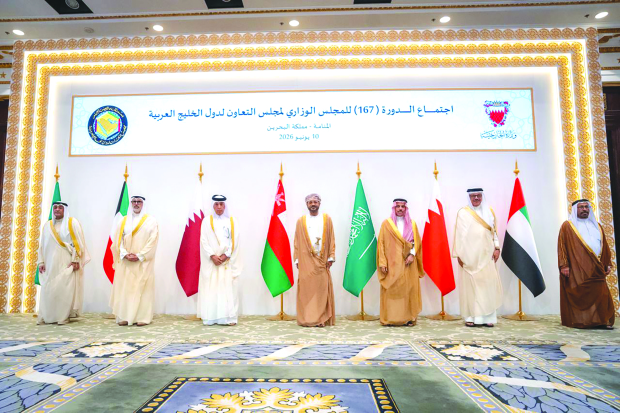
While the GCC remains committed to peace and stability, this commitment should not be interpreted as weakness, and that the defence of sovereignty and the security of its people are non-negotiable principle.
Foreign Minister and current president of the GCC Ministerial Council Dr Abdullatif Al Zayani said the Council will continue to take all legitimate measures to safeguard its security, as he chaired the 167th session of the Council.
The session was attended by GCC foreign ministers and Secretary General Jassim Mohammed Al Budaiwi.
Dr Al Zayani also noted that the opportunity remains open for those opting for the use of force to reconsider their approach, either by engaging in peace and co-operation or by continuing on the course of isolation and marginalisation.
Dr Al Zayani conveyed the greetings of His Majesty King Hamad and His Royal Highness Prince Salman bin Hamad Al Khalifa, Crown Prince and Prime Minister, expressing their hopes that the meeting would strengthen Gulf co-operation and integration across all levels.
The Foreign Minister said the meeting was taking place amid serious and dangerous challenges, noting the Iranian attacks that had targeted infrastructure, economic facilities and residential areas in GCC states, causing significant loss of life and property.
He also highlighted the impact of the closure of the Strait of Hormuz on maritime navigation, international trade, energy supplies and the global economy, in clear violation of international law, the United Nations Charter and principles of good neighbourliness.
He added that the Iranian attacks on Bahrain and Kuwait yesterday were part of an ongoing hostile approach, constituting a blatant violation of state sovereignty and international legitimacy, and contradicting the principles of Islam which call for the rejection of aggression and the preservation of life.
He said that air defence systems had successfully and efficiently intercepted the attacks.
Dr Al Zayani said GCC states had faced this aggression with confidence, capability, resolute solidarity and high readiness.
He expressed pride in GCC leaders for their wisdom and foresight in addressing the developments and dealing with the Iranian attacks and those of its proxies, while maintaining commitment to principles of good neighbourliness, regional security and stability, and the protection of the peoples of the region from the dangers of war.
The Foreign Minister noted that the ministerial meeting followed the 19th consultative meeting of the GCC Supreme Council held in Jeddah on April 28, which discussed developments and the implications of the closure of the Strait of Hormuz. He expressed pride in the Supreme Council’s recommendations for effective and sustainable responses to developments and for strengthening joint Gulf action.
He added that, as part of Bahrain’s presidency of the current GCC session, the kingdom had submitted a guiding paper to the Council reflecting the vision of His Majesty to consolidate co-ordination, integration and interconnectedness among member states across all domains within the GCC framework, and to reinforce a unified Gulf stance in favour of peace and good neighbourliness.
Dr Al Zayani also expressed the pride of GCC states, both leadership and peoples, in the efficiency and readiness demonstrated by the armed forces and air defence systems in countering Iranian attacks and protecting civilians and residents. He extended condolences for the victims and wished the injured a speedy recovery.
He also commended the security agencies of GCC states for their vigilance, which enabled them to uncover networks linked to the Iranian Revolutionary Guard and arrest their members, reflecting high national readiness in safeguarding sovereignty and security.
Dr Al Zayani praised the effective diplomatic efforts of GCC states at the United Nations to mobilise support and condemn the Iranian attacks.
He noted that Bahrain, in its capacity as president of the current GCC session and as a non-permanent member of the UN Security Council, and during its presidency in April, ensured that the GCC voice was heard, resulting in the adoption of UN Security Council Resolution 2817 (2026), a unanimous Human Rights Council resolution, and an International Maritime Organisation resolution achieved through the efforts of the UAE as a member of the organisation, alongside other resolutions condemning the attacks on GCC states and Jordan, and calling for the protection of freedom of navigation and an end to support for armed militias.
He said that while GCC states had demonstrated their defensive, security and political capabilities in confronting the aggression, they had remained advocates of peace, de-escalation and diplomatic mediation as the best path to resolving conflicts. He stressed that real security could not be achieved through force or instability, but through adherence to international law, respect for sovereignty and good neighbourliness.
The Council discussed agenda items related to the path of joint Gulf action, including the outcomes of the 19th consultative meeting of the GCC Supreme Council held in Jeddah.
The Council reviewed the kingdom’s document reflecting the vision of His Majesty to consolidate co-ordination, integration and interconnectedness among member states across all domains.
The Council also examined recommendations from specialised ministerial committees and reports from the GCC General Secretariat on areas of joint co-operation and means to advance it amid political and security challenges facing GCC states, as well as the outcomes of strategic dialogues with other countries and international blocs.
The Council reviewed a report on the progress of negotiations on free trade agreements with a number of countries, welcoming the conclusion of negotiations with the UK and the signing of a joint statement, as well as the launch of negotiations with India.
The Council also discussed regional developments and continued Iranian attacks.
The GCC foreign ministers stressed the need to intensify international efforts to warn against the continued closure of the Strait of Hormuz and its impact on energy security, food supply chains and international trade.
&uuid=(email))