

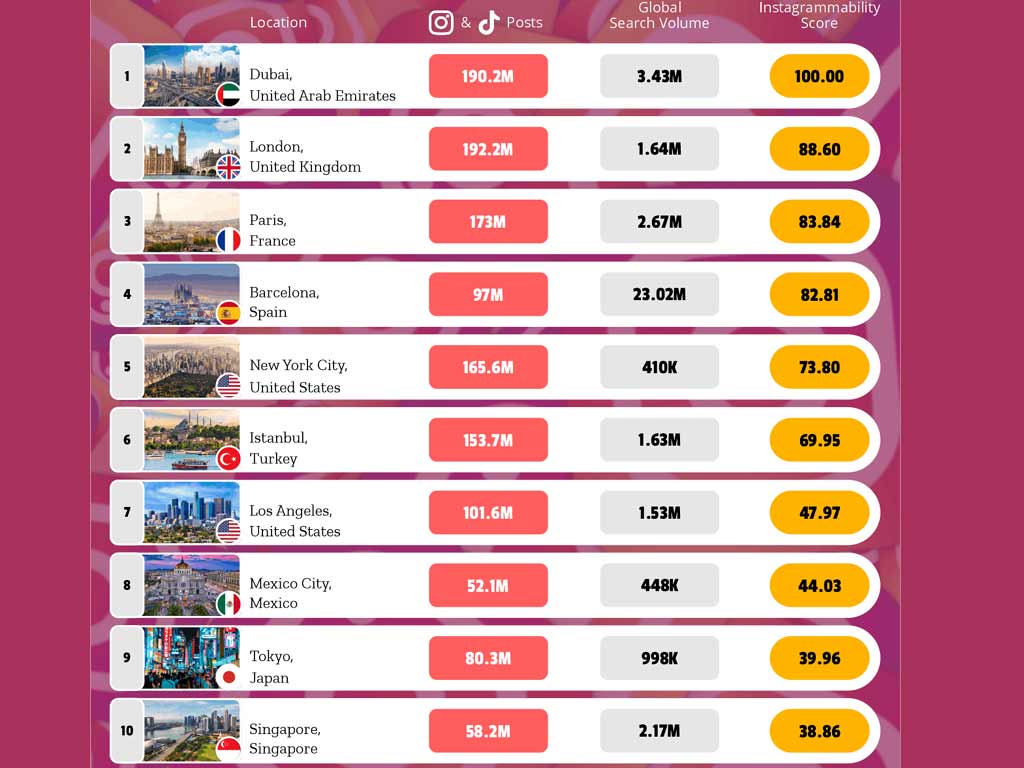
With an Instagrammability score of 100, Dubai tops the ranking of the most photographed cities in the world. It has been tagged 147 million times on Instagram and more than 43 million times on TikTok.
Barcelona records 97 million tagged posts alongside 23 million monthly global Google searches, nearly seven times the search demand of Dubai. No other city in the dataset comes close, making Barcelona the most actively searched destination, says the Players Time Instagrammability Score report.
Burj Khalifa is the most tagged (10.1 million posts) and most searched landmark on the Internet, with over 1.1 million monthly Google searches, more than double the Eiffel Tower (662,000) and ahead of the Grand Canyon (696,000).
Urban destinations dominate the 2026 Instagrammability ranking, where cities operate less as individual landmarks and more as complete visual ecosystems shaped by density, lifestyle, and scale.
At the top, Dubai leads with a score of 100, supported by over 190 million Instagram and TikTok posts and 3.43 million monthly searches, positioning it as the global reference point for luxury-driven travel content.
London and Paris follow closely, reinforcing the continued dominance of established global capitals. London records the highest hashtag volume with 192.2 million posts, while Paris maintains a strong balance between social visibility and consistent search demand. Barcelona, meanwhile, stands out with 97 million posts and 23 million monthly Google searches, a combination that reflects something deeper than tourism, a city that has become one of the defining travel obsessions of the moment. New York City also ranks among the top performers, with 165.6 million posts highlighting its enduring presence across platforms.
Beyond the leading group, the ranking reveals a strong European concentration, but also a number of less expected entries. Cities like Istanbul continue to perform at scale, with 153.7 million posts, yet others, including places like San Diego, Santiago, or Kochi, appear despite having a far lower global profile. This points to a clear disconnect between recognition and visibility. Instagrammability is not limited to the most famous cities, but extends to places that perform strongly on visual platforms, regardless of how widely known they are.
Global landmarks - Burj Khalifa at the top
At the top of the 2026 global landmarks ranking sits the Burj Khalifa, not an ancient wonder or centuries-old monument, but a modern building completed in 2010 that has managed to outphotograph everything else on Earth.
With a score of 100, over 10 million tagged posts, and 1.1 million monthly searches, the 828-metre tower redefined vertical construction and became the world’s most Instagrammable landmark in the same way Dubai became a global tourist destination: by building something the world had never seen before.
The Eiffel Tower follows in second place with an Instagrammability score of 73.22, a result that will surprise no one, but whose consistency across both social media and search reflects the endurance of certain global icons.
Beyond the top two, the ranking reveals a more layered geography of attention. Europe accounts for 8 of the top 20 landmarks, making it the most heavily represented region in our ranking, with places such as the Sagrada Família and the Colosseum reflecting this strong presence through search volumes ranging from around 313,000 to 737,000 monthly queries and millions of social media posts.
Meanwhile, the Taj Mahal and Machu Picchu rank even higher, with search interest between roughly 854,000 and 928,000 and similarly strong engagement across social platforms, showing how both cultural heritage and digital popularity converge at scale.
Some places earn their position not through outstanding architecture or cultural significance, but through experience alone. At Tokyo’s Shibuya Scramble Crossing, with up to 3,000 people crossing at once, the experience is the landmark, generating over 6.57 million posts from within the flow itself. New York’s Times Square operates in much the same way, an environment rather than a destination, producing 5.82 million posts from a space so visually intense that putting out your camera becomes instinct.
Perhaps the most revealing detail in the ranking is the Brooklyn Bridge’s DUMBO viewpoint, which has generated over 4 million posts on Instagram alone despite modest search demand. It is less a planned destination than a passing moment, one people photograph almost reflexively, adding to a figure that keeps rising regardless.
Unusual places
The top spot in the world’s most Instagrammable unusual places in 2026 belongs to Setenil de las Bodegas, a small Spanish town where, for centuries, houses have been built directly into overhanging rock faces, creating surreal streetscapes, that appear as if they were made up inside someone’s mind rather than real. Its score of 100 reflects a rare balance: enough people searching for it to signal genuine global curiosity, and enough tagged content to confirm it delivers on the visual promise.
Japan’s Hitachi Seaside Park takes second place on the strength of something as simple, and as fleeting, as flowers. Every spring, its hills turn an almost unreal shade of blue as millions of nemophila blooms open simultaneously, producing images so saturated they routinely get mistaken for digital edits. With just 21,000 monthly searches on Google, it remains relatively undiscovered outside Asia, which may not last much longer.
Wave Rock in Australia and Cano Cristales in Colombia, a river that runs simultaneously red, yellow, green and blue during its seasonal peak, round out the top four, demonstrating how geological oddities translate directly into social media staying power. Goblin Valley in Utah follows closely, its hoodoo-covered terrain generating nearly 50,000 tagged posts despite modest global search interest, while Ukraine’s Tunnel of Love, a railway line swallowed entirely by arching trees, sustains a quietly devoted following with 53,500 posts and just 5,900 monthly searches.
China’s Huanglong Scenic Area, with its vivid travertine pools cascading across a mountain valley, and Switzerland’s Titlis Cliff Walk, Europe’s highest suspension bridge, occupy the lower-middle of the ranking, both generating limited search volume but retaining strong niche visual appeal. At the foot of the table, New Zealand’s Moeraki Boulders and the bioluminescent beach of Vaadhoo Island in the Maldives close out the list. - TradeArabia News Service
&uuid=(email))