

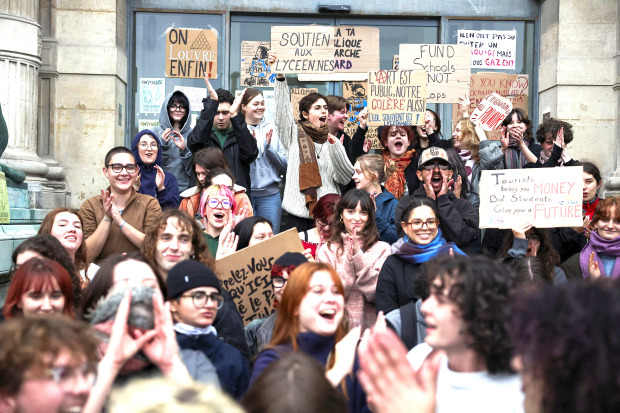
French student unions vowed yesterday to keep up protests after scoring what they called their first win in a campaign that is increasingly supported by Paris’ elite universities, with 141 schools still shut around the country.
The protests have snowballed into a wider movement, with more university students weighing in to express their anger over what they call a dysfunctional system, worsened by spending cuts spurred by France’s budget crunch.
Student and teacher unions have called for another round of nationwide school strikes next Tuesday.
France’s education ministry is in the process of urgently contacting around 3,000 spare teachers who could be sent to schools with the most pressing needs, often located in low-income areas, Education Minister Edouard Geffray said.
Speaking during a visit to a school in the Paris region that was vandalised during protests, he said more than 100 teaching staff had been injured so far in the nationwide protests.
The movement has fueled similar student protests in Belgium, which yesterday were amplified by a national strike during which scuffles broke out between protesters and police in Brussels.
Police cleared a blockade at Assas university, a top French law school in central Paris, yesterday morning. Nearby, elite engineering school Mines Paris was also disrupted by blockades.
The Institut Catholique, a private university known for being particularly conservative, said on its website it would switch to remote classes due to a blockade of its campus.
Student unions meanwhile hailed what they see as their first real win, after the government late on Thursday pledged to send some 3,000 teachers, who are fully qualified but have not yet started work, to fill staffing gaps, one of the protesters’ main grievances.
The move, which the government called an ‘emergency plan,’ shows it is worthwhile for students to continue their protests, Marius Mesnil, from a high school student union, told Franceinfo radio.
“I find it crazy we need to block hundreds of high schools just to get a vacancy plan,” he added.
The measure is effective immediately and will cost ‘several dozen million euros,’ Geffray told broadcaster TF1 late on Thursday.
Three weeks into the protest, President Emmanuel Macron’s government is struggling to work out how to balance demands for more education spending with the need to rein in public debt.
Investors are closely watching the government’s next moves in a highly indebted country where street anger has often been tamed with more state spending.
This time, France’s large pension outlays and its need to rein in public spending leave little room for manoeuvre.
&uuid=(email))