

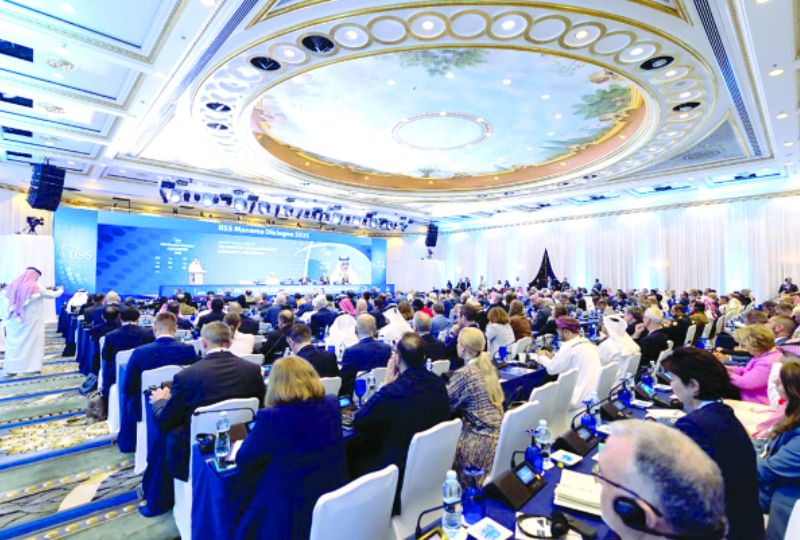
The Manama Dialogue 2026 is more than an annual gathering to discuss security and defence. Bahrain is hosting this year’s event at a critical moment, with the Gulf region caught in a war it did not choose but whose security, economic and strategic repercussions it must endure. This comes amid Iranian attacks that threaten Gulf stability and a vital energy lifeline on which the global economy depends.
For many years, we have listened at this forum and other international gatherings to officials, diplomats, military leaders and experts discuss the strategic importance of the Gulf region, its pivotal role in global security, and its contribution to energy markets and international trade.
However, the recent war has put these statements to a real test. Will the world’s recognition of the region’s importance lead to a genuine commitment to its security, or will it remain a theoretical assessment that falls short in times of crisis?
Rapid developments have revealed that recognition of the Gulf’s importance has not always been matched by a practical commitment commensurate with it. They have also shown that, in the eyes of many, international responses have fallen short of the challenges facing the countries of the region and the scale of global interests tied to their security.
This raises a key question for the Manama Dialogue: if Gulf security is integral to global security, why is this not more clearly reflected in international policies and responses when Gulf states come under attack?
The significance of the Manama Dialogue 2026 lies in its focus on the war and its consequences, including the launch of ‘The Gulf at War’ dossier and discussions on the political and security lessons of the Iran war. Other key topics include regional security, defence, resilience, deterrence, maritime security and global security governance.
These themes must not remain subjects of theoretical debate. Rather, they should pave the way for a serious review of existing policies and a clear determination of what regional and international partners must do to prevent further attacks, protect maritime navigation and energy supplies, and strengthen the region’s capacity to confront crises. The forum is expected not merely to offer a new description of the risks facing the region, but to help formulate practical solutions commensurate with the scale of those risks and their impact.
Bahrain hosts this forum out of a firm belief in dialogue and international partnership as foundations of security and stability.
However, such partnerships are not measured by the regularity of meetings or the volume of statements issued, but by their ability to protect shared interests, respect state sovereignty and adopt clear positions when a country in the region comes under attack.
True partnerships are tested during crises, when action matters more than statements and mutual commitment becomes the measure of the credibility of international relations.
Any future dialogue with parties to the conflict must be grounded in clear principles: respect for international law, state sovereignty and territorial integrity, rejection of the use or threat of force, and non-interference in internal affairs.
Lasting security cannot be built without these foundations, nor can Gulf states be expected to engage in arrangements that offer no credible guarantees for their sovereignty, people or resources.
A unified Gulf position is equally critical. Challenges facing any GCC state do not stop at its geographical borders; their effects extend to the security and economies of the entire region and to the interests of its peoples.
Unifying the Gulf’s voice, strengthening political and security co-ordination, and agreeing on priorities for dealing with crises are therefore strategic necessities.
These are essential for sending an unequivocal message to the world that Gulf security is a collective responsibility that cannot be divided.
Responsibility also extends beyond governments. Research centres and experts participating in the forum should move beyond analysis and offer practical, actionable proposals.
These centres should recognise that the Gulf is not merely a theatre of competing interests; it is a key pillar of the global economy, energy security and international trade, and its security concerns deserve equal consideration.
Bahrain’s message at the Manama Dialogue 2026 is clear: Gulf security is inseparable from global security.
Protecting it requires genuine partnerships, concrete action and unwavering respect for international law and sovereignty.
The time has come for the world to move beyond acknowledging the importance of this region and to commit to safeguarding it.
The true measure of the dialogue’s success will lie not in identifying risks, but in delivering the solutions needed to prevent them from recurring.
