

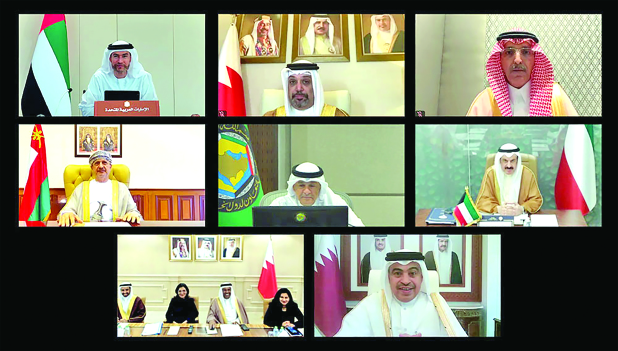
Finance and National Economy Minister Shaikh Salman bin Khalifa Al Khalifa chaired the 125th meeting of the Financial and Economic Co-operation Committee of the GCC states, held via video conference as part of Bahrain’s presidency of the 46th GCC session.
The meeting focused on enhancing financial and economic co-operation between member states.
Shaikh Salman said Bahrain, under the leadership of His Majesty King Hamad and with the support of His Royal Highness Prince Salman bin Hamad Al Khalifa, Crown Prince and Prime Minister, remains committed to strengthening Gulf co-operation and building on shared development achievements to meet the aspirations of GCC leaders.
The Finance Minister thanked Kuwait for its efforts during its previous GCC presidency and also expressed appreciation to GCC secretary general Jasem Al Budaiwi and the general secretariat team for preparing the meeting.
He said GCC countries had faced unprecedented missile and drone attacks linked to Iranian aggression, targeting residential areas, civilian infrastructure, energy facilities, desalination plants, ports, fuel storage sites, airports, hotels and universities. He described the attacks as a serious violation of international law and a threat to regional and global security.
Shaikh Salman added that disruptions to shipping in the Strait of Hormuz had highlighted the importance of international co-operation to protect maritime routes and global trade. He noted that more than 20 per cent of global oil and liquefied natural gas supplies pass through the strait, along with over 27pc of global aluminium exports and more than 30pc of fertiliser exports.
The Finance Minister said the attacks had negatively affected GCC economies, but stressed that close co-operation between GCC states had helped limit the impact and strengthen resilience, underlining the need for deeper regional integration.
He also praised Saudi Arabia for supporting GCC countries by opening its airports and airspace, and by easing customs and transport procedures to speed up the movement of essential goods across the region.
Shaikh Salman welcomed the currency swap agreement signed between the central bank of Bahrain and the UAE, describing it as an important step towards stronger financial co-operation and wider use of local currencies in bilateral trade.
The Finance Minister expressed confidence that the meeting’s decisions would support Gulf economic integration and strengthen joint GCC action.
The meeting also reviewed several agenda items, including measures undertaken in response to current developments, progress in GCC free trade agreement negotiations, updates on economic unity efforts, the GCC payments linkage system, follow-up on committee decisions and other shared economic and development matters.
Shaikh Salman separately chaired the ninth meeting of the Permanent Preparatory Committee at the ministerial level of the GCC Economic and Development Affairs Authority, held virtually.
He emphasised Bahrain’s commitment to advancing Gulf economic integration and accelerating joint strategic projects in support of the resilience and growth of GCC economies.
The meeting discussed means to strengthen economic integration among GCC countries.
Shaikh Salman highlighted the importance of enhancing co-ordination and joint Gulf action amid regional and international developments.
The Finance Minister underscored the importance of accelerating the implementation of joint GCC projects, including the Gulf railway project, electricity and water interconnection projects, oil and gas pipeline projects, and proposals related to GCC strategic reserves.
He expressed hope that the meeting’s outcomes would support broader Gulf economic integration and contribute to development, prosperity, and stability across GCC countries.
&uuid=(email))