

Bahrain has welcomed the statement issued by members of the United Nations Security Council condemning the missile attacks carried out by the Iranian-backed Houthi terrorist militia against Saudi Arabia, its targeting of commercial vessels.
It also highlighted the UN statement’s emphasis on upholding international law and relevant Security Council resolutions, respecting the sovereignty, unity, independence and territorial integrity of Yemen, and safeguarding freedom of maritime navigation.
In a statement, the Foreign Ministry affirmed Bahrain’s full solidarity with Saudi Arabia and its support for all measures undertaken to safeguard its sovereignty, security and stability and protect its vital interests.
The ministry also stressed that the security and stability of Saudi Arabia are an integral part of the security of Bahrain and all GCC member states.
It expressed Bahrain’s appreciation for Saudi Arabia’s diplomatic, developmental and humanitarian efforts through its leadership of the Coalition to Support Legitimacy in Yemen, in support of a comprehensive and sustainable political solution in accordance with the GCC Initiative and its Implementation Mechanism, the outcomes of the National Dialogue Conference, and relevant Security Council resolutions, foremost among them Resolution 2216, which aim to preserve Yemen’s unity, sovereignty, independence and territorial integrity.
The ministry also commended Saudi Arabia’s vital role in establishing the multinational maritime defence coalition to enhance security, safeguard freedom of navigation and international trade, and protect global energy supplies.
The Houthis, meanwhile, resumed attacks on the Red Sea port city of Mocha, a Yemeni military spokesperson said.
The Yemeni military said on X that air defences were intercepting a number of drones, adding Houthi attacks targeted residential neighbourhoods in Mocha.
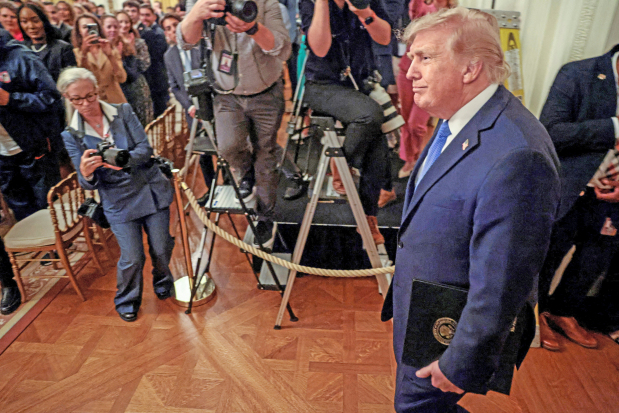
After months of US military strikes on Iran, sanctions and a blockade, President Donald Trump said yesterday that his administration is watching economic pressure mount on Iran, according to an interview with Axios.
“We are low keying it,” Trump was quoted as saying during a brief phone call.
“We are only semi-negotiating with them. We are just watching Iran with its huge inflation and the fact they have no money.”
Iran said that a deal with Oman defining new shipping lanes in the Strait of Hormuz was in its final stages.
But it reiterated that the waterway would only reopen once the United States met other conditions.
A US official told Reuters on Friday that an agreement between Iran and Oman was close and could soon reopen the waterway, which carried a fifth of global oil and liquefied natural gas shipments before Iran blocked it in response to US and Israeli attacks.
Iranian Foreign Minister Abbas Araqchi said yesterday an agreement on the Strait that lies between the two countries was in the ‘final stages’ but repeated comments made on Saturday that it would not reopen it unless other conditions were met.
The agreement would set out the new shipping lanes to be used once the US fulfils those conditions and the strait is reopened, Iran’s Mehr news agency quoted him as saying.
Iran and the US are not engaged in talks and Tehran will not start them as long as Washington breaches an interim deal signed in June, Araqchi said, adding that messages are being exchanged via intermediaries.
The United States began air strikes on Iran in late February saying it aimed to ensure the Islamic republic could not acquire nuclear weapons or threaten the region with missiles or proxies. It agreed a ceasefire with Iran in June, but reimposed a blockade on Iranian shipping in the Gulf in July, which Tehran said was a violation of the truce that had already broken down.
“Once the deal is announced to restore commercial shipping without impediments, the United States will lift the blockade of Iranian ports,” the US official told Reuters on condition of anonymity.
US actions would be tied to Iran’s implementation of its commitments, the official said. The US comments indicated delicate sequencing towards a deal that sources had told Reuters appeared to be set to give Tehran control over ships entering the Gulf through the strait, something shippers said was not easily workable.
The latest status of the agreement was not clear and Iran’s response suggested other factors would also come into play.
Ultimate decision-making in Iran rests with Supreme Leader, Mojtaba Khamenei, who has not been seen in public since an air strike killed his father and predecessor on February 28, the first day of US-Israeli air strikes on Iran.
State media said President Masoud Pezeshkian had met Khamenei in late July and a paramilitary leader promised footage of the supreme leader, who was reportedly injured in the strike that killed his father, out in public.
The UAE said on Saturday that Iran had attacked a ship affiliated to its state oil company.
&uuid=(email))