Bahrain’s telecommunications sector reached unprecedented levels of data consumption in the first quarter of this year, driven by robust expansion in fixed fibre broadband and high-bandwidth mobile subscriptions.
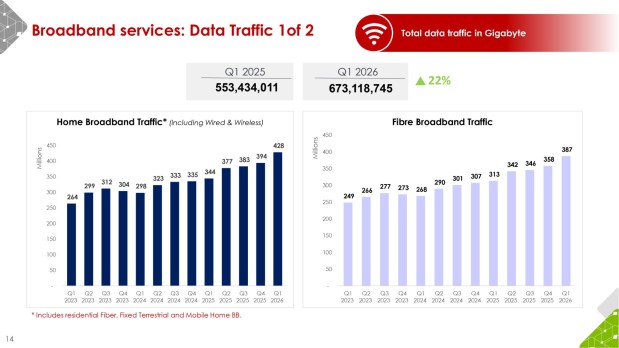
According to the latest official market indicators report released by the Telecommunications Regulatory Authority (TRA), overall quarterly data traffic escalated to 673 Petabytes (PB) – a sharp increase from the 553 PB recorded in Q1 2025.
To put that into perspective, a single petabyte holds roughly 300 million smartphone photos, 500,000 standard movies, 15 years of continuous HD streaming, or 2,000 years of non-stop music.
The remarkable surge reflects an ongoing structural shift across the kingdom’s digital ecosystem. While consumers and enterprise clients consume exponentially higher volumes of online content, traditional voice communications – both domestic and international – continue to decline.
Total outgoing mobile voice traffic fell to 647.3 million minutes in Q1 2026, marking a 16.9 per cent drop compared to 778.6m minutes in the same period last year.
Active mobile subscriptions stood at 2,286,794 at the end of the quarter, representing a national mobile penetration rate of 143pc based on an official population baseline of 1.603m residents.
A notable trend within the mobile segment is the steady migration from prepaid to postpaid billing plans. Prepaid subscriptions contracted from 1,561,086 in Q1 2025 to 1,460,704 in Q1 2026, now constituting 64pc of the market.

A breakdown of telecom market indicators for the first quarter of this year
Conversely, postpaid residential subscriptions expanded to 714,317, while non-residential postpaid accounts reached 111,773, bringing total postpaid market share to 36pc (826,090 subscriptions).
Market share distribution among Bahrain’s three primary mobile network operators – Batelco, stc Bahrain and Zain Bahrain – remained highly competitive and stable.
Batelco retained its market leadership in total mobile subscriptions with a 38.6pc share, followed by stc Bahrain at 32.3pc and Zain Bahrain holding 29.2pc.
In the prepaid segment, Batelco leads with 39pc market share, Zain holds 34pc (490,403 residential lines), and stc Bahrain has 27pc (400,805 residential lines).

Conversely, stc Bahrain maintains dominance in the postpaid sector with a 41pc overall market share, supported by 298,629 residential and 38,240 non-residential accounts. Batelco captures 38pc of postpaid subscriptions, while Zain holds 21pc.
Fixed line telephony subscriptions (excluding ISDN) totalled 209,955 in Q1 2026, preserving a steady penetration rate of roughly 13.2pc over the past five quarters. The vast majority of fixed access lines – 95pc (200,000 lines) – are fixed wired connections, while fixed wireless accounts for the remaining 5pc (10,000 lines).
Batelco continues to hold a dominant position in fixed telephony with a 76.5pc market share, although alternative operators have gradually gained ground, led by Zain at 13.4pc, OLOs at 5.2pc, and stc Bahrain at 4.9pc.
Voice traffic metrics illustrate a continuous contraction across fixed networks. Total outgoing fixed voice traffic declined by 14pc year-on-year, dropping from 27.5m minutes in Q1 2025 to 23.7m minutes in Q1 2026. Monthly average outgoing domestic minutes per line decreased from 41 to 36 minutes over the same period, while international outgoing fixed minutes dropped from 1.08m to 834,249 minutes.
Bahrain’s broadband sector remains the core growth engine of the telecom market. Total broadband subscriptions (combining mobile and fixed broadband, excluding M2M) reached 2,600,450 in Q1 2026, achieving a population penetration rate of 162pc. Mobile broadband accounts for 2,411,845 subscriptions (150.4pc penetration), while fixed broadband subscriptions grew to 188,605.
Fibre-To-The-Home (FTTH) deployment continues to advance rapidly across residential and commercial areas.
Residential fibre broadband subscriptions reached 171,973 in Q1 2026, while non-residential fibre lines rose to 14,207, pushing total fibre connections to 186,180 – accounting for more than 98.7pc of total fixed broadband lines.
Household fibre penetration reached 76pc, based on the latest Information and eGovernment Authority (iGA) baseline of 244,976 households.
In terms of data traffic, fibre infrastructure carried 388 Petabytes of data in Q1 2026. Average monthly data usage per fibre broadband subscription reached an extraordinary 687 Gigabytes (GB) per month, compared with an average of 20.5GB per month per mobile broadband subscription.
Meanwhile, the Machine-to-Machine (M2M) and Internet of Things (IoT) landscape contracted slightly to 585,000 active subscriptions in Q1 2026, down from 627,000 in Q4 2025.
Point of Sale (POS) terminals represent the overwhelmingly dominant M2M application, comprising 509,000 connections (87pc of total M2M subscriptions).
Utility infrastructure deployments continued to expand, with Electricity and Water Authority (EWA) smart meters reaching 65,000 active lines (up from 52,000 in Q1 2025).
Vehicle tracking units accounted for 29,000 lines, while miscellaneous IoT applications made up the remaining 13,000 connections.
According to an expert, the TRA’s Q1 2026 market data underscores a mature telecommunications market transitioning towards high-capacity broadband infrastructure and automated IoT services.
avinash@gdnmedia.bh