

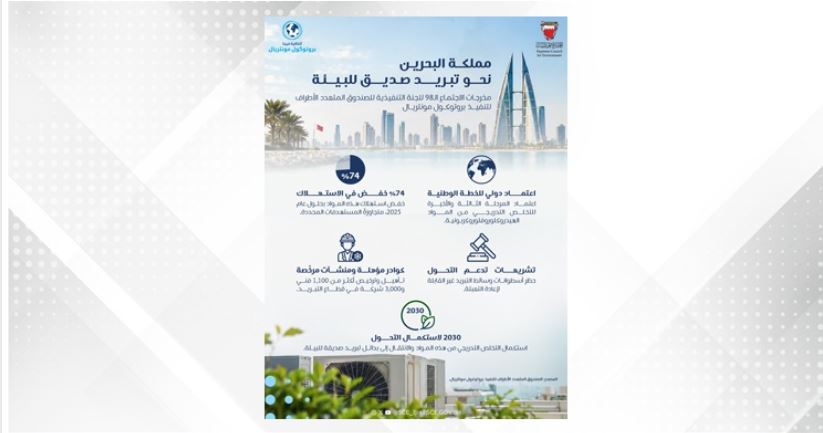
The executive committee of the Multilateral Fund for the Implementation of the Montreal Protocol has approved the third and final stage of Bahrain’s Hydrochlorofluorocarbon Phase-out Management Plan (HPMP), at its 98th meeting.
It highlighted Bahrain’s progress in establishing an integrated regulatory and monitoring framework for managing refrigerants and phasing out ozone-depleting substances.
The plan is led by the Supreme Council for Environment (SCE) and represents a further milestone in Bahrain’s implementation of its commitments under the Montreal Protocol.
In a special report issued on the kingdom’s experience, the Multilateral Fund highlighted Bahrain’s success in exceeding the reduction targets set under the first and second stages of the plan, achieving a 74 per cent reduction in HCFC consumption against the 2025 baseline.
The fund described Bahrain’s experience as a model that could provide valuable lessons internationally in managing the phase-out of environmentally harmful refrigerants.
It said Bahrain’s progress was supported by a strong regulatory and institutional framework integrating legislation, monitoring, capacity-building and infrastructure development. The national framework includes the qualification and licensing of technicians and companies operating in the refrigeration and air-conditioning sector, a ban on the direct release of refrigerants, mandatory recovery, recycling and reclamation, and leak monitoring for large systems.
The fund also noted that Bahrain is the first country in the region to ban the use of non-refillable refrigerant cylinders.
The report highlighted the establishment of the National Refrigerant Reclamation Centre and the development of a national recovery, recycling and reclamation network, in addition to an electronic system regulating the import and export of refrigerants. Requirements and standards have also been introduced for refillable cylinders, filling operations, labelling, reclamation and disposal, contributing to the operation of four refrigerant filling centres in the kingdom.
In the area of capacity-building, the fund highlighted Bahrain’s national programme for qualifying and licensing workers in the refrigeration and air-conditioning sector, which currently covers around 1,100 licensed technicians and 3,000 licensed companies and workshops. The programme is supported by an integrated database enabling the relevant authorities to verify licence validity, strengthen inspection and monitoring, and track establishments and technicians operating in the sector.
Bahrain has also introduced further regulatory measures, including a ban on the import and manufacture of air-conditioning equipment using HCFC-22 and a ban on HCFC-141b contained in pre-blended polyol mixtures, effective from January 1, 2025.
Licensing requirements for activities involving refrigerants have also been strengthened, alongside expanded requirements for recovery and reclamation and monitoring of large refrigeration and air-conditioning systems.
The third and final stage of the HPMP will build on these achievements by strengthening regulatory oversight and digital monitoring and reporting systems, enhancing compliance and traceability through integrated licensing and technician qualification systems, and supporting the planned ban on HCFC imports by 2030.
The fund said Bahrain’s experience in implementing the HPMP provides a strong foundation for developing an integrated system for managing refrigerants throughout their lifecycle and supporting future investments under the Kigali Amendment Implementation Plan (KIP), further consolidating the kingdom’s environmental and institutional achievements.
&uuid=(email))